Image

Like most people, in my early childhood I was no more at odds with the world than freshly formed Adam. While my father, a Palestinian refugee, was working as a civil engineer in Libya, my Irish mother, my brother, and I occupied a villa in the Metn hills above Beirut, with a view of Our Lady of Harissa. It was a tiny place where the squat-down toilet doubled as a shower. We were surrounded by the squabble and stench of our landlord’s chickens, frequent invaders of the house, my mother dubbing one particularly persistent berserker Clueless the Barbarian. My brother and I ran wild in those sunny hills and spoke Arabic with my cousins, aunts, and uncles. I might have ended up an unhappy engineer in the Gulf, but my father, driving through the desert at night to bail out a friend from jail, hit an oryx (perhaps the last one at that time—they were extinct in the wild by the early ’70s). He survived for three days in an American army hospital that wasn’t equipped well enough to realize his spleen had ruptured.
In the blink of an eye, the sun, red-soiled hills, sweet halva, and barbarian chickens of Lebanon all vanished, a shift, I imagine, akin to a reversal of that magical moment in The Wizard of Oz when monochrome Kansas becomes Technicolor Oz. I didn’t end up, alas, in the legendary London of Carnaby Street and the King’s Road, but in my grandmother’s tiny council flat in Kilburn, a neighborhood of Irish immigrants. I have a vague memory of a man lying unconscious in the street, a bottle of purplish methylated spirits beside him, a dark patch expanding at his crotch. My language, such as it was at four, was a patois of Arabic and English. I found myself in a flat, gray world with endless, sepulchral winters, vaults of livid cloud low enough to touch, darkness at 4 p.m. The smell of pine, cypress, and juniper had transformed into the rich, sad petrichor of the city—its public urinals, the sooty diesel of the wheezing buses, the stale breath of the tube.
I lost a life. To be uprooted in this way, to have every taste, color, sound, texture, scent of your young life abruptly replaced, is to absorb contingency (dissolved in a solution of mild trauma) into your very bones. You find yourself not in a world, but a theater, brought to life by the players and by the grace of your own imagination. Until such time as you meet people who are like you, you feel you are the only audience for the world’s performance, an exhausting burden that perhaps explains why I spent most of my childhood desiring only to retreat. It isn’t a good way to live, to be, since nothing is real. Until it is dreadfully real.
Artists are often liminal beings. This may be because they’re second-generation immigrants, caught between two traditions, or because of a sexual identity that sets them at odds with a dominant culture, or just because they are in some existential way, as a writer I once met at a residency described himself, “incompletely born into the material world.” He was trapped, he claimed, between heaven and Earth, death and life, a citizen of the hypnagogic realm. I believed him. While at a café late one evening, I caught sight of him in the street, looking as if he’d walked straight out of a dream. Possibly on his way to a date or birthday party, he was holding a small, beribboned box and sporting a blazer made of something silky, glowing bluely iridescent in the streetlight, as if woven from the cuticles of bluebottles. His face was malevolently blank, and I imagined that the box contained one of those dead fetal chicks you often find on the sidewalk in spring with a glittering ooze of ants upon it.
(One time, during a period when I was being self-destructively negative about my life, I related this story to my brother while trying to make him understand my own torturous liminality. He mockingly screwed his fisted hands into his eyes and said, “Oh, boo-hoo, boo-hoo. A ghost whose farts stink, fancy that!”)
Liminal or otherwise, we are none of us a single coherent self, but a barracks of beings, people from our pasts. Some of these we have integrated. They emerge in our voice and our gestures, influence the shifts of our emotional weather, and can fully, even frighteningly, possess us at times. Others remain whole, unassimilable, which gives them an idolic power. If we are lucky, we will also be occupied by at least a few people we admire and love, some of them even ascending to those from whom you can draw strength in times of trouble, our vagabond saints.
After our life in my grandmother’s tiny flat became intolerable, my mother moved us to a flat in a large block near Hammersmith on the South Circular. This block was my world. Those with idolic power in this place were the fathers of my friends, who crushed their children and dominated their homes. But if I had to choose one person to embody that world, to carry that story, it would be Hugo Moretti, one of the boys I grew up with, first among equals in my pantheon of vagabond saints.
Hugo was a hefty boy with small, delicate hands and feet. His dense bowl-cut brown hair resembled an acorn’s cupule. I recall his gently beseeching eyes, his smile ever at the verge of a laugh that rarely came. He wore chunky charity-store sweaters so garish I suspected he was color blind. His Spanish mother, Adela, came to England from Valencia at sixteen to be an au pair for a couple who lived on Richmond Hill. The man, a surgeon, made her pregnant and immediately fired her, denying the child was his. Too ashamed to return to her Catholic family, she married a chef, Santino. He was from an aristocratic Italian family. Classically educated, when he failed to succeed as an opera singer, he pursued his other great passion, haute cuisine, becoming a sous chef at the Savoy. He soon opened his own restaurant in Knightsbridge. It failed, beginning his descent through increasingly humbler establishments. When Hugo appeared in my life at thirteen, Santino had rented the restaurant beneath our flat to run what was essentially a burger joint.
Santino could recite Dante by heart in spine-tingling Italian. He sang arias in his lyric tenor while he cooked hamburgers for Hugo and me. I could hardly believe the volume and emotional power of the sounds issuing from his gangly body. But like too many of my friends’ fathers, he drank, and when he did so, the gall of his failure surfaced, this bitterness focusing on Adela, che puttana! and on Hugo, il piccolo bastardo della mamma. A little parasitic bastard he had to clothe and feed. Adela, with her lush dark hair and husky voice, was an object of desire for me, her quality of vulnerability and desperation fueling my youthful fantasies. In this I was already becoming some combination of the surgeon, who seduced her, and Santino, desperate to possess and control a woman far out of his league. Like Cio-Cio-San, Lucia, or Gilda, she was the perfect tragic heroine: beautiful, exploited, benighted, dreaming ever of true love and escape. I was a weird, sensitive teenager who liked talking to adults, and she was lonely enough to unburden herself to me. She told me all about the surgeon: Such a clever, cultured man, she whispered proudly. Though she never dared say a word about Santino, always glancing around uneasily when I mentioned him, she confided that she was stealing money from the restaurant’s till, gathering a nest egg to facilitate her and Hugo’s escape. She was isolated and being constantly moved around (this was Santino’s fifth restaurant). Looking back on it, I can recognize the telltale signs of abuse.
I also recall the bruised bags beneath Hugo’s eyes after long hours at the restaurant, where Santino worked him like a mule. The burns on his arms, the raw redness of his hands from the harsh cleaning agents, the heels of his old shoes worn to wedges that further exaggerated his rolling gait. But Hugo was indefatigable, dutiful, and uncomplaining. I have rarely met anyone gentler or more kind, always solicitous and attentive. He never seemed sad, nor ever truly joyful. I took advantage of his reflexive instinct to serve others. He’d rub my back on command. He’d clean my room as I sat on the bed chatting with him. What little pocket money he received, he spent on gifts, sentimental figurines for my mother, or sweets he’d share, with unfathomable generosity, with my brother and me. It did not occur to me until much later that he felt he had to pay for whatever scraps of kindness might be thrown his way. He escaped to our house as often as he could, sometimes sleeping on the floor between my brother’s bed and mine in our tiny bedroom.
When we were fifteen, our O level exams looming, Santino declared that they were moving again, this time to his culinary nadir, a fish-and-chip shop in Wapping. It was decided that Hugo would stay with us until his exams were over. In that year and a half, Adela called to speak to her son only twice, and they never sent a penny to support him. After O levels, I was packed off to a boarding school in Cambridge for my sixth form by one of my wealthy Palestinian uncles and lost touch with Hugo. Four or five years later, I was home for Christmas from university, and on Christmas Day, out of the blue, he turned up at our door. After a brief visit, on his way out, he invited me for a drink one evening.
I met him at a pub near Leicester Square. He was with his girlfriend, Sadie, who looked a decade older. She was already drunk, her eyes smeared with black mascara, her expression skidding between a doll-like vacuity and a vengeful scowl. She insisted on going to a club, so we wandered through Soho until we found a basement space throbbing with music and lights, its open door flanked by a monstrous bouncer and a slick Mephistophelean man dubiously assessing the worth of our souls. The club itself was like being inside a migraine, a seethe of shadowy people in demonic strobes. After running out of money for the overpriced drinks Sadie was rapidly downing, we caught the Tube to Kilburn Park station and walked to a brutalist tower block on Carlton Vale. The graffitied lift to their flat stank of urine, their schizophrenic neighbor out on the landing, raving. Inside, Sadie filled a tankard with rum, flopped down on the floor, and drank as Hugo gently rubbed her back, just as he used to rub mine.
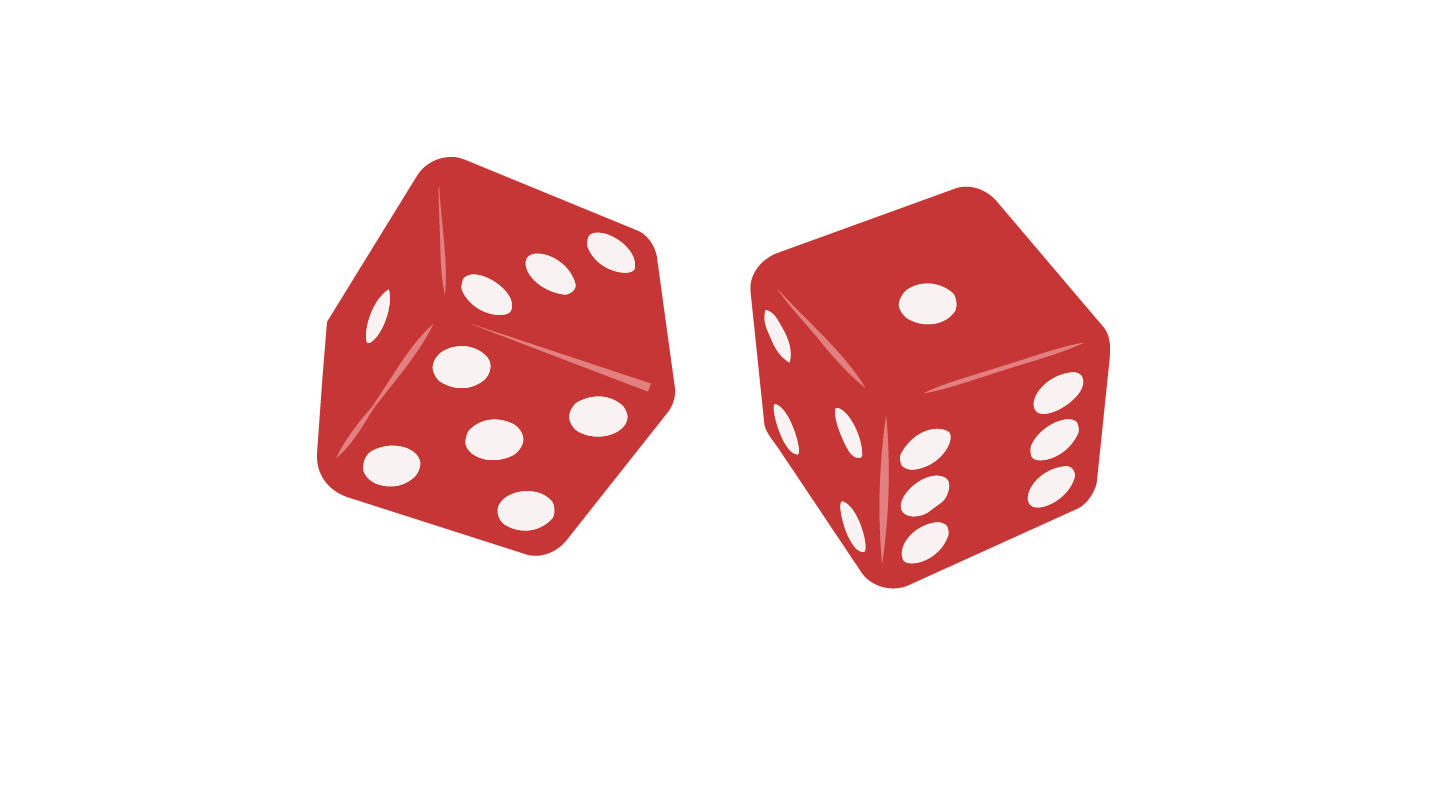
It was too late to go home, so I spent the night. The next morning, a Sunday, he took me to his place of work at a nearby industrial estate. He had a key to it. It was a small factory that made casino paraphernalia: chips, plaques, roulette balls, baccarat rakes, card shoes, and so on. He brought me to some machines that manufactured dice, and produced a set for me, red with white dots. In 1984, Orwell highlights the evils of the lottery, no doubt influenced by his time in Spain, where tickets were sold by the poor, who often carried them on strings around their necks—the destitute yoked to dreams of untold wealth. Outside the factory, we hugged goodbye. I had endured this weekend for his sake, and I knew I would not see him again. I spent my life running away from my past, my childhood, from every self that threatened to coalesce out of a world that was, at best, not my world and, at worst, painfully inimical to me. I was young enough and unhappy enough to believe that one day my world and I would perfectly align, making me whole again. Perhaps, without realizing, I was still looking for the paradise I had lost: red soil and sunlight and marauding chickens. In its pursuit, I left so many people behind, people whose friendship and love I could not have faith in, whose connection was to a person I wanted to shed.
During that last embrace, clutching those dice, I experienced an almost overwhelming sense of déjà vu. I had been here before, perhaps countless times, every detail at once new and numbly familiar. I needed to notice something, to understand something, to ask the right question, like Percival in the Grail castle; to ask “What ails thee?” I had also failed him by not recognizing that he knew I wasn’t present, knew that his friend, who should have loved him, had cauterized him. Now I have spent most of my life haunted and trying to make sense of just such moments as that final parting outside Hugo’s factory, moments of estranged intimacy, of intimate estrangement, those singularities of human connectedness into which all our stories collapse, out of which they explode.
I still remember the feel of the dice in my fisted hand as I walk away from him through that dispiriting industrial park with its low and mostly derelict red brick warehouses, butterfly bushes angling out of cracks in the mortar, pigeons dropping in suicidal squadrons from the eaves. My Irish mother has made me superstitious: no new shoes on the table or there’ll be a death in the family; when you see a single magpie, salute and spit. Those dice were given to me by a man with no luck. That twenty-year-old me is not acting consciously; there’s nothing logical in this process. I pass a rubbish bin, but I can’t do that. Nor can I keep them. As I turn onto Kilburn High Road, I’m saved. With one last squeeze of the dice, like that of a craps player before the fatal throw, I drop them into the rectangular mouth of a postbox.
Jenn Boggs is the Art Director and graphic designer at VQR.