Image

When my mother left my father for a forklift operator over in Memphis, she dragged us along on weekends so we could get to know her. My brother and I understood we were to keep certain things to ourselves. If asked, Joyelle wasn’t her girlfriend but a friend from the church-choir circuit. Our parents continued living in the same house, but separately. There’d been a time our mother, a contralto, called our family her main quartet. And my father, a physicist, liked the symmetry: each of us, our own equal part. Except we weren’t equal. There were fundamental forces shaping our entire universe, as he’d taught us, and some forces, like our mother, were more powerful than others. If our mother wanted to live two lives, in two states, nothing was going to stop her.
After school on Fridays, Mom would pull up, bags already packed in the back of the Pontiac, and we’d drive Highway 72 straight into the setting sun. The speed limit leaving Riddle Green, Alabama, was fifty-five. She’d be going seventy, eighty, ninety. It was a three-and-a-half-hour drive to Memphis, and we’d have to make it by dinnertime. I’d been doing simple algebra with my dad since I was six, and I knew we’d need to push a hundred to make it. But I never said anything. Mathematical realities didn’t apply to our mother.
When the local gospel dropped to fuzz, she’d turn the radio dial to a Muscle Shoals station. The brassy punch of a high school marching band would fill the van, and our mother’d roll down the windows and smile. Maybe it was because we rarely saw her content, but I found her smile unusual. More like an animal baring its teeth than a grin, but it was genuine. My brother and I knew this because we were used to the opposite. Like every woman in a long line before her, my mother wore her bitterness on her face. As if the weight of her life swung from a set of hooks tied to where her smile ought to be, she had the sad scowl of a catfish. We watched her face closely, examining her dark-brown eyes for changes, same as we’d grown up watching the sky for a turn in a storm. No howling sirens announced the dangerous shifts in her bad moods.
When she sang, though, especially on the road, my brother and I were a private audience to a nearly carefree Mom. On our drives to Memphis, wind slapping through the van, she’d tap out the rat-a-tat-tats on the steering wheel, hum the bum-bum-bum-bums.
“You know this song?” I asked, one Friday night, as we charged down the highway to the boom-bang of a marching band. “Or are you happy because you’re kidnapping us?”
“You know your mama was a majorette!” She was the only person I knew who spoke of herself in third person, earnestly.
“You’d’ve had to tell us you were a majorette for us to know you were a majorette.”
“Don’t be a butthole,” my brother said from his spot riding shotgun. He’d take her side even if she was holding my head under water. “I’ve seen her baton.”
She tousled his hair.
There were her teeth again.
The farther we got from home, I swear, the angles of her body got softer, her curls looser. Out the van’s windows, there wasn’t much other than cotton fields and bean patches until we hit the star-spangled trailers selling fireworks at the state line. We’d pull into downtown at dusk, as the neon started to light up the strip.
The first Friday, we parked in a city lot and my mother pointed toward an alley where Joyelle would be. My brother leapt from the van and ran, Mom calling after him to stop. There was a large crowd, more people than I’d ever seen on one street, and we lost sight of him in the rush. My father was a theoretical physicist who worked as a missile risk analyst for the Department of Defense on the Redstone Arsenal, and I thought of him, calculating the possibility of my brother being kidnapped or run over. He worked in the nuclear division and reminded us, often, that doom waited around every corner. I could hear him, in his droll voice, citing statistics on missing children. I chased my mother, sidestepping and pushing through people stalled on the sidewalk, never losing sight of her. She was too tall to lose sight of. I should have been afraid she’d leave me behind, her long strides outpacing mine. I should have been afraid to be in a big city, far from the rural town where you were as likely to see a horse on the main drag as a car. I wasn’t. There was an unnerving feeling that I’d give in to the temptation of the crowd and drift into the blur of bodies, to disappear completely.
Joyelle was waiting for us, cross-legged on a bench, the marquee of the restaurant glowing in gold above her head: Rendezvous. By the time we made it down the alley, my brother was buried in Joyelle’s lap. Mom wrapped her arms around both of them. We hadn’t seen her in a few months since our father found out and banned Joyelle from our home. I showed more restraint, but it was good to see her again.
Joyelle ushered us inside, greeting everyone like they were her favorite cousins. She and her friends were different from our parents. Back home, if we saw someone we knew at a restaurant, there were the polite hellos, maybe a handshake, and before we were seated, my mother or father would lean toward one another, whispering. This was their most intimate gesture, to quietly critique anyone, for any reason, at any time, together. Joyelle’s friends asked one another about their families and bad backs and whether they’d been fishing and why the hell not. Her friends descended on me and my brother like our congregation flocks to visitors on Sunday. There was talk of going to another place after dinner. An open mic. They wanted to hear our mother sing.
More people arrived and the greetings began again. Joyelle and her friends didn’t hug so much as envelop one another, arm fat and bellies and thighs devouring the other’s in these long, full-body embraces. It wasn’t sexual as far as I could tell. I scanned these physical encounters for some sign of the sins our preacher said would be clandestine.
I couldn’t help but think of my English teacher, Ms. Wiley, and the last time I’d seen her. She’d been fired over Christmas break, and I hadn’t known if she was still in town when our family drove the half hour to Cracker Barrel and ran into her. There’d been rumors she drank more than coffee all day. She had these tremors. And when she’d lean over your desk to correct your paper, dangling from her arms were long moles that shook like small, frightened animals. I liked Ms. Wiley and her weird animal moles. After our hellos, as she walked away, my mother whispered into my father’s ear. With a concerned look, he asked: “A blow job?” And Ms. Wiley, who’d whipped around as I’d turned to see if she heard, gave me a pitiful wave goodbye.
They warned us at church to be discerning. To never trust an adult we met outside of the First Baptist halls. Our father preferred we not trust anyone, ever. These happy people inside Rendezvous might be evildoers. I didn’t necessarily believe this anymore, but the power of suggestion being what it is, I did look for evil. For a reason to whisper to my brother we were in a bad place. For a reason to not be happy.
My brother and I didn’t find the devil in Memphis.
Who we found instead was Joyelle’s mother, a short, squat woman with silver hair, at a table in the back. Surprisingly, in the loud dining room, Joyelle’s mother was reading a book. It was like finding a shiny silver dollar on a dusty mountain trail. When she saw us, she pulled off her glasses, which were attached to a colorful chain, and set them on her broad chest.
“You two,” she said. “I have something for you, in case you get tired of all this desultory chitchat.”
She tucked her own novel into her bag and retrieved two slim books. My brother’s was a collection of funny stories, something I’d read a hundred times in elementary school, but mine was a play by August Wilson. The Piano Lesson. I’d never heard of it. We told her thanks and took the seats beside her.
“Go on. Read. Don’t feel like you have to keep an old lady company.”
I remember thinking, very clearly, with immediate anguish and excitement shooting through my middle like something hot, This could be my new family. My brother must have had a similar thought with a gentler reaction, because he was telling her about our grandparents, who took us to the library over in Huntsville once a week. He said our grandmother looked like her: chubby, pretty. Joyelle’s mother laughed. My brother could do this, befriend someone in an innocent instant. See the good in them.
Eventually, my mother found her way to the table with Joyelle, and they sat across from us, and the way we were seated, in the center of a long table surrounded by Joyelle’s people, it felt like a reception. At home, a night like this would be ruined by something that upset my mother, some remark or tone of voice my father deployed that would set her off. He worked with land mines as a young physicist and accused our mother of having a more sensitive detonation trigger. Like an explosion, our mother’s rage, once unleashed, was unstoppable. We couldn’t calm her. She had to wear herself out. A special occasion back home often ended with her flipping over her chair, abandoning us at the table to march through the house. To scream and cuss and hiss. She might smash a trophy through a window or rip a phone from a wall. In the morning, we’d thank her for the meal and go on with our day. But with Joyelle, the evening passed as if we were ordinary people.
And so, our weekday activities continued as they always had: school, Wednesday night church, music lessons and errands in our regular life. And our weekends looked entirely different: the drive from Alabama into Mississippi and then Tennessee, where me and my little brother became happy tourists in another life.
In the beginning those Memphis weekends were gold. Joyelle escorted us to all the sightseeing spots, where we posed for her disposable camera like figures in postcards: curling our lips at Graceland, waddling like the ducks on parade at the Peabody. Our mother was starstruck. Enamored by the city’s music history, the working musicians. She couldn’t stand like a normal person for pictures. She held her fist to her wide mouth, crooning.
Friday nights in Memphis we especially loved. Friday nights we weren’t yet homesick or worried about what our father was doing to pass the time. We weren’t obsessing over whether or not people back home were gossiping about our mother losing her mind. Friday nights were for barbecue and booths draped in blood-red vinyl, where our shoes smacked the sticky hardwoods like hungry lips. And our mother, her girlfriend on her arm, was this other, glowing person.
It was like we were on a movie set, like we’d crossed state lines into another dimension where human encounters lacked the mysterious societal rules we’d been raised by.
As we entered a restaurant, Joyelle had a line cast from her mouth before the door swung closed behind us: What’s good, Ronny?…Been too long, Mr. John.…My god, it smells like heaven in here, Ms. Donna!
I began to suspect none of it was real. Not in a hallucinatory way, just that everyone must have been in on something, and me and my brother were the butt of some complicated joke or the specimens of an experiment gone awry on the arsenal. My mother’s church was the church, but my father’s church was his work on the arsenal. Redstone Arsenal was home to the Army, the Air Force, NASA, the FBI, and six days a week—when he wasn’t traveling—our father. It was where he spent ten to twelve hours a day, where he wore his best suits and carried a locked briefcase and met with military officials and aerospace engineers about top-secret security matters. On the arsenal, he and the other rocket scientists had purpose, respect. They ran important tests, conducted world-changing experiments. He was the beloved physicist who could explain the most complicated of problems to the dumbest lieutenant colonel. Occasionally, from our old house five miles away, we’d hear an echoing boom, feel a shudder like an earthquake, or catch a rotten-egg odor that wasn’t the usual sulfuric wash from a crop duster. We’d joke it was Dad, saying hello.
Joyelle welcomed us into a world where people were glad to see us. In Joyelle’s favorite spots, it seemed like there was always an ancient woman behind a glass candy case who would call us over and drop from her blue fist into our open palms hunks of pink bubblegum. On the counter, there’d be a thin metal stake piercing a mountain of pale-yellow tickets. There were fishbowls of Andes mints, trees made of Dum-Dums. Wrapped around huge collection jars were fundraising flyers—for a line cook recovering from a hip replacement, new tires for the pitmaster, a favorite customer’s sick kid. We slung our own spare change into these jars, me and my brother staring into the photos of bald children whose smiles seemed bigger than our own.
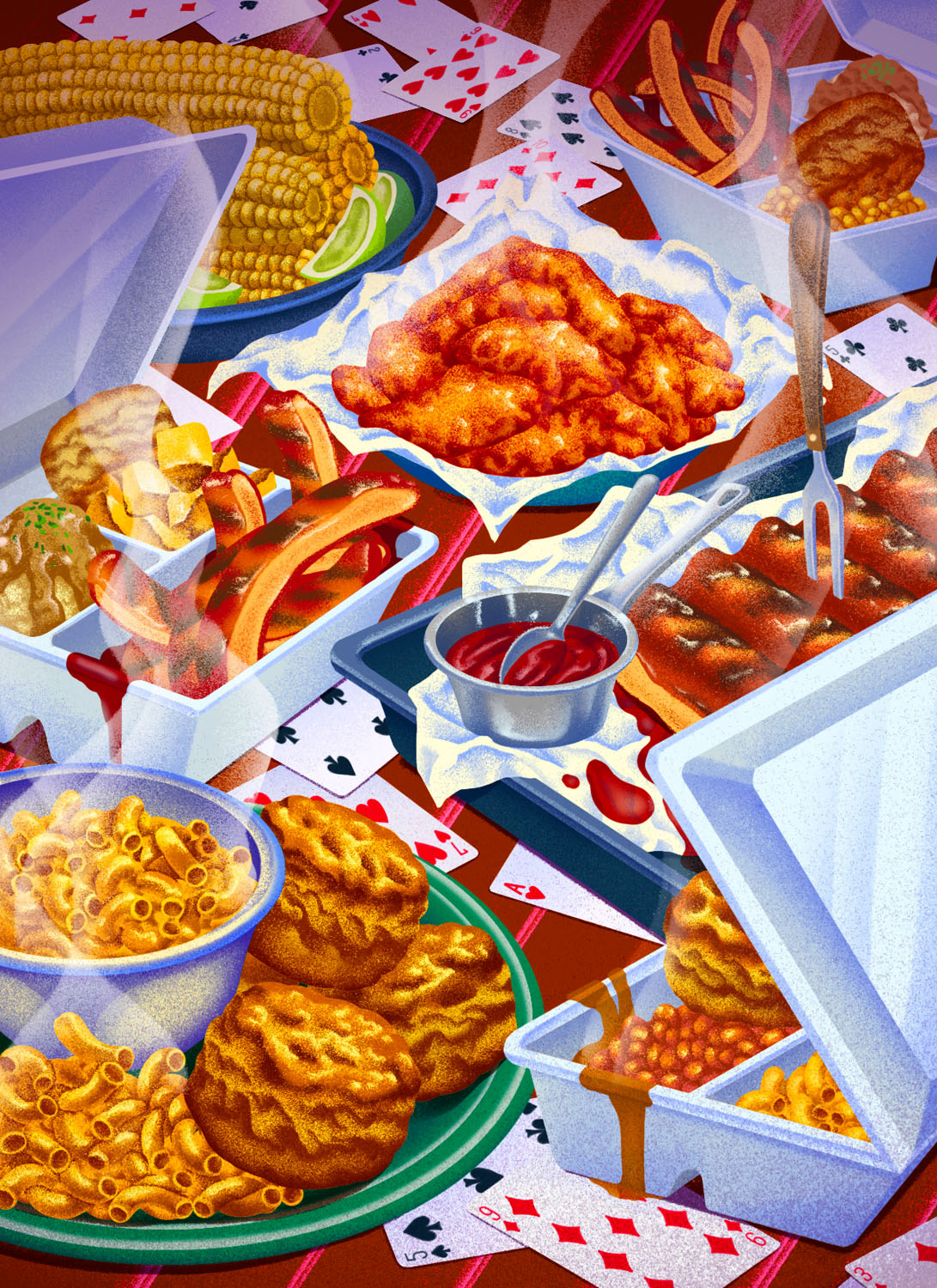
The waiters were effusive. They brought us extra baskets of hush puppies or sliced white bread. They piled the mac and cheese high next to pools of baked beans and turnips. Thick pads of butter melted and slid off our corn on the cob. Fried yellow onions lay like crowns on the potatoes. We ate pulled pork and chicken wings and ribs by the pound. At home, the barbecue sauce was white, sweet with a hint of pepper; here it was red, tangy. We never ended a night without going to the cooler to pick out a slice of lemon icebox or sweet potato pie. By the end of a meal, our bodies were heavy, content.
Though he didn’t need to, my brother would beg me not to bring up our father. As if the thought of Dad didn’t belong here, or that by bringing him up we’d somehow break the spell. We hadn’t been told not to, but it was clear that in order to have a good time in Memphis, it was better to try not to think of him returning home after a late night working to the dog eating cat shit from the litter box. It was better to not mention him at all.
On the tabletops, once the dishes or baskets were cleared, once a waiter brought us Styrofoam containers stuffed like the collection plates on Easter morning, we’d play cards. My brother and I had invented a game similar to solitaire where two players moved the deck together. We called it double-dare. Joyelle would time us to see how quickly we could get our sets, her head leaned against my mother’s shoulder. Mom was tall, the lean was easy. If my brother was uncomfortable with their affection, he never told me so. We’d been taught at church people who lived like this were hell-bound. But our mother, for once, was calm. Every now and then, whether or not anyone had said anything, she laughed a low laugh in harmony with the slow sounds coming from the speakers. And like so many other things we saw in Memphis, this laughter was new to us too. We stopped watching for the change in her eyes. We’d sit like this for hours. No one rushed us even as the waitstaff started to set chairs on the tables to sweep.
Joyelle moved through these dinners like a dancer on a stage, elegant, buoyant, in sync with some music we couldn’t hear. Everywhere she took us, people bent to her, moved with her, stepped in time with her and, by extension, us.
My brother and I learned how to split ourselves in two. We could be one way at home, one way in Memphis.
That year, whenever we were in Riddle Green, and Mom was shuttling us in the van to and from school or church or the ball field, she started singing songs she’d never sung in the church choir, songs that made her groan and hum and shimmy those tight shoulders. At red lights, she’d close her eyes, and instead of where we really were, behind a tractor at the intersection for Foodland and the BuyWise Drugstore, I figured she, like us, was imagining we were back in Memphis. We made up excuses for missing weekend slumber parties or recitals. I got kicked out of the National Junior Honor Society. My brother missed his best friend’s birthday party. We told people our mom was singing in a busy traveling choir. She never mentioned these sacrifices or if she saw them as sacrifices. If our father had been at home more reliably, she might not have taken us at all.
Our dad stayed later and later on the arsenal. He flew to other cities where the government met to discuss ballistic defense tactics and to even farther places, remote islands, where they tested these tactics. He returned with souvenirs from the airports and then just the crumbled packs of cookies from the plane ride home. Sometimes when we were in Riddle Green, out riding our bikes while Mom cooked dinner, we’d see him, circling the block in his station wagon and then turning back onto the main road, heading west toward the highway, back to his office. If we closed our eyes, we heard the Beach Boys’ “Wouldn’t It Be Nice” coming from his open window. We’d find him in the morning, snoring on the couch.
He had one cassette. The Beach Boys Greatest Hits. He married a woman who loved music, who’d sang in a choir since she was a small child, and yet he seemed to have no interest in it other than an obsessive habit to listen to the same twenty songs on repeat.
In the dimly lit, aromatic dining rooms of the Memphis joints, (Joyelle taught us to call them joints), there were shrines to the musicians who’d made the city what it was. We didn’t recognize any of them except for Elvis. Maybe we had some vague familiarity with Johnny Cash or B. B. King. I won’t pretend we knew blues, or soul, or hip hop, or old country. I was thirteen. My brother was ten. We were two white children of two white parents who’d raised us to be a family as square as the blue field of the American flag. I don’t know what culture we had by then other than memorized scripture and the jokes from afternoon sitcom reruns. We knew some gospel and the top forty. Joyelle taught us about music, about movies, about a living politic. They were lessons her mother taught her. Her mother, who had a new book for us whenever we arrived. And Joyelle, seeing we loved this tradition, cleared a bookshelf in her den to be our library. Not that either of us remembers now all the stories she told or the albums she played. We just remember the way she loved things. The way she loved people, and us.
Joyelle was nothing like our mother. We’d never had a name for the change we saw in Mom, but one Saturday morning, Joyelle warned us when her mutt got a similar glass-eyed stare. We were in her backyard, under a wide elm tree, tossing a tennis ball for the dog who’d suddenly stopped and was crouched low to the ground, eyeing us.
“She’s telling you she’s spooked, so you gotta back up. Might not be something you two are doing but you don’t want to risk a bite.” There was no panic in her voice, only instruction. “It’s something reminding her, you know? Reminding her of before.”
By before, she meant wherever the dog was before she stumbled into Joyelle’s yard. On bad days, my brother and I started saying Mom was stuck in the before.
Back home, we attended one of the biggest Southern Baptist churches in Alabama, where services were broadcast on an access channel for the homebound. Our grandparents were elders in the church and brought to prayer group each week, alongside a corn or chicken casserole, requests to pray for my mother’s infidelity and sexuality. Somehow this didn’t deter our mom. Our family was in mandatory attendance on Wednesday nights, Sunday mornings, and for weeklong Bible camps in the summer, where we made promises from the pulpit to preserve our virginity in the name of Jesus. By the time I was fifteen, after one of my friends was raped by a youth minister, I’d learn that the ordained men in our congregation took brief hiatuses after a “fall”—an affair or inappropriate relationship or act of violence—reemerging in other churches once rumors died down. But that’s a different story. Or maybe it isn’t. Like I said, our mother’s church was church. These were our mother’s people. These were the people she raised us to emulate. They were the architects of her before.
If we were lucky to be in Memphis on a Sunday morning, we avoided the awkwardness of Joyelle and our mother emerging from the back bedroom by walking a few blocks to Joyelle’s mother’s house. We’d find her in a yellow silk robe, having coffee on what she called the porte cochere. What was meant for a car was made up with patio furniture and a garden of potted plants. She’d hand us each a watering can, and for our services we were awarded cinnamon rolls and access to her painting supplies.
One sunny morning, a glob of white icing on the corner of his mouth, my brother asked Joyelle’s mother: “Why don’t you go to church?”
“If God made all this,” she said, waving as if she meant everything under the bright blue sky, “aren’t we already there?”
Her plants dripped, green all around us. Hummingbirds fought at a feeder made of amber-blown glass. Her fat calico cat was asleep in my lap. My brother was working on a portrait of our mother, singing a solo at church. Her proportions were misshapen but not wholly incorrect. He held it up for us to see.
“I can’t ever get her right,” he said, licking his lips clean.
On Sundays back home, we’d wake early to find our mother at the breakfast table painting her nails, vocalizing unintelligible words to warm up her voice for choir. Our student Bibles would be stacked on the kitchen counter next to the stovetop where a tray of burnt biscuits and a skillet of cold eggs waited. In the den, our father’d be in his wrinkled suit, his breakfast half-eaten on a paper plate on the coffee table, the Weather Channel droning on as he’d fish for some scrap of work in his briefcase. We eyed the dial of the turn-style lock, hoping to learn the code, but he always spun the numbers to 000 once the case was open. Mom would put on the same small, spiral gold earrings and gold cross on a plaited chain, wear a pleated dress with a matronly print. Her dyed dark hair curled high above her ears.
In Memphis, our mother looked like the women we’d seen that summer at the Lilith Fair: denim that hugged her body, ankle-high leather boots, open-collar button downs, big colorful hoops in her ears. She stopped fussing with her hair. Neither of my parents drank at home, but when the waiters in Joyelle’s friends’ restaurants brought Mom a cold beer, on the house, she drank it in slow, savoring sips.
She tried so hard to play the part of herself.
We’d seen her sing a million times in church. There are photos of her at a Christmas Eve service, alone on the chancel floor, surrounded by evergreens and poinsettias, wearing a white robe like a tent, so pregnant with my brother she looks like a celestial body glowing beneath candlelit stained glass and the brass pipes of the organ. We used to make fun of her for singing with the same high and mighty voice to the radio. We’d be listening to 104.3 WZYP, and whatever pop song came out of the Pontiac’s speakers came out of our mom’s mouth like it was “Do You Hear What I Hear?” In this other city, in this other life, Mom’s voice took on a lower volume, a velvety tone, moodier but somehow more dire than when she sang for our salvation. With Joyelle on her shoulder, she sounded just like Bonnie Raitt, singing “I Can’t Make You Love Me.”
After she and Joyelle broke up, Mom quit singing altogether.
The same frustrations that had plagued our mother’s relationship with our father had stalked her all the way to Memphis. At home, Mom would stomp and scream and throw things, and Dad would mock her, laugh in her face, call her a nag. Joyelle respected our mother, tried to coax her away from anger with all her charm and compassion, but she couldn’t. When our mother went to that place, no one could reach her.
The night things ended, we were in a parking lot after dinner, and Mom asked Joyelle a question we didn’t hear. When Joyelle told her to mind her business, playfully, our mother didn’t take it as a joke. There was a moment I saw the flash in her eyes, the change, and I hoped it was only a reflection. I hoped she was still hypnotized by the lights of Memphis. But Mom said, “Excuse me?” and we knew. Without a word, our mother pulled from the to-go bag of food two large glass mugs she’d purchased for us as souvenirs, and she hurled them at the building’s brick wall.
“Goddammit!” We’d never seen Joyelle shaken. She turned to us. “I’m sorry. Are y’all all right?” We knew better than to react, but our parents had never apologized before, not to us.
Our mother looked at us then—really looked at us. I couldn’t remember a time when I’d seen her face so bare. I wanted her to smile. I wanted her strange affection. It’s so stupid, wanting a person to be another way. But instead of smiling her jaw jutted out, making her face flat and wide, her eyes narrow. I tried to imagine what she was thinking when she saw us, what she wanted from us.
“Come on, guys,” Joyelle said. She put her arms around my brother and me, pulling us to her hips, moving like she’d take us back inside.
“Oh, don’t you fucking dare,” my mother said.
My brother shot a look at me as he pulled away from her, slipping his ballcap down low on his eyes. This, we knew. When our mother went into the before, if someone didn’t indulge her, didn’t bow to her, she could terrify. But she never hurt us. She’d never hurt us.
I looked at Joyelle and she had on her face the same pathetic, pitiful expression I’d seen on Ms. Wiley. I realized then Ms. Wiley hadn’t been embarrassed by whatever rumor sparked my mother’s comment. Ms. Wiley was embarrassed for me.
I shook loose from Joyelle’s embrace. I was my mother’s daughter, after all. And a kid can only tolerate so much.
“You think some lesbo knows us better than our own mother?”
“Of course, I don’t think that—”
My mother didn’t let her finish. I don’t remember what she said, but Joyelle left us then. There was no real goodbye, no hug or pitiful wave. She went back inside the restaurant where she had friends. Whatever fun she returned to, we went the opposite direction. We stayed at a motel on the outskirts of town with the dresser pushed in front of the door. The next morning, we drove home in silence.
The following Sunday, we were back in church with Mom. One of the oldest women in my grandparents’ Bible study sat behind us, and when the service ended, she handed us each a note, written on a prayer request card. The same verse, for each of us. Is anyone among you in trouble? Let them pray. Is anyone happy? Let them sing songs of praise. Is anyone among you sick? Let them call the elders of the church to pray over them and anoint them with oil in the name of the Lord.
I thought of Joyelle’s mother and wondered what she hadn’t had a chance to give us. There was a line in the August Wilson book, the first one she gave me, about strangers who treat you like family. A family who treats you like a stranger. Who were they, Joyelle and her mother, to us? What were we supposed to do with them?
My dad stopped going to church. He swapped his one Beach Boys cassette for language lessons. He started driving us to school in the mornings. None of us could worry over what was or wasn’t being said if we were practicing asking for directions in Mandarin. Ms. Wiley returned as a test-prep tutor. Apparently, she’d gone through treatment, found God. There were little white scars now where her moles had been, and around her neck, a jeweled cross. I quit pre-AP English to avoid her.
By the end of the school year, Dad would have his own poorly furnished apartment and the cat. We stayed behind in the house. One night a week, we went to his apartment to eat beef stroganoff Hamburger Helper or Happy Meals. He still picked us up in the mornings to take us to school, Mom asleep or something like it in her dark bedroom. On Saturdays, Dad would come home to mow the lawn, and the dog would howl from a small outdoor pen. Joyelle would make a mistake on her forklift. Something about a bad turn, and the sharp pull of the steering wheel, her thumb caught in a wrung and nearly torn off. She was out of work for months but swore her friends had her covered. Her mutt was a great nurse. She’d be all right. My brother had called her one night when his homesickness for her got to be too much and hearing this news, he was convinced we’d done it, that maybe one of us had brought up our father while we were in Memphis and somehow broken the spell. My mother was more direct. Other than her absence in the audience of our spring recital, we were oblivious until, years later, we’d learn the old woman from our church had prayed over Mom while she had her stomach pumped. She never mentioned Joyelle, or Memphis, again.
Neither did we. We kept our end of the deal.
At night, we’d hear our mother downstairs on the phone, her voice raspy, urgent. Sometimes we tried to guess if it was Dad. Sometimes, Joyelle. Sometimes, we wished a secret government agency would call to tell us our father was a hero, a genius who developed a way to end nuclear threats, and we’d all need to come right away to some island where he was being hidden.
Sometimes, we wished our mother would quit pacing the house and just go to sleep. When we couldn’t take it anymore, my brother and I crawled from our beds and lay on the floor, our ears pressed to the hardwood, trying to discern if the sounds she made were sobs or laughter, or maybe, if we were lucky, a song.
There was the before.
And there was the after.
For a while, and my brother and I had the pictures to prove it, there was Memphis.
One Friday night, at a hole-in-the-wall on South Second, just off the river, while we finished our banana pudding, a band set up on a makeshift corner stage. Four old guys. Two Black, two white. Drums, bass, guitar, keys. An hour into their set, they started taking requests, and someone called out, “Bad Luck Woman.” When the guitarist said his voice wouldn’t do it justice, Mom volunteered, unable to hide her unusual smile as people cheered.
Onstage, there was a humming beat as the musicians tuned up. The place buzzed with clinking glasses and expectant chatter. Joyelle stuck two fingers in her mouth and whistled. All eyes were on our mother. Who did they see? The guitarist leaned over to adjust her mic stand and said something into my mother’s ear. And this part feels like a miracle, the mic caught her whispered response: “God, if that ain’t the truth. I am lucky.”

Dani Choi is a South Korean–born illustrator whose work has appeared in The New York Times, The New Yorker, and Poetry. She has won two New Talent World Illustration Awards from the Association of Illustrators, including selection as an Overall Winner in 2021.