Image

Then these women in a van pulled me into it and we passed one around.
“Feel the muscles on this one.”
“I’m gonna feel me some Baby Peaches.”
“Baby Peaches, where you walkin’ lookin’ like that? Oh my.”
This was in an alien era, back in ’94 in Myrtle Beach, the June heat so hard it hit you as sound. I was late for the gym; a bikers’ festival had throttled in that weekend and 17 was logjammed, absolutely impassable. I had the ’89 Buick Regal my mother had given me after her last divorce, but it was parked half a mile away in the lot of the store that sold seashells. That’s where I’d made up my mind to hoof it, though I’d ducked inside for a minute just to make it look legit. You could not believe the size of this store, and it sold only seashells. And you further could not believe that diagonally across 17 there was another store—a competitor, I suppose—that sold seashells. Why didn’t tourists just walk a block and collect them on the sand for free?
I’d never before imagined anything remotely like this scene. I’m from New Jersey. The beach was magically foreign in every way, just what I needed. I was twenty-one years old and poetical.
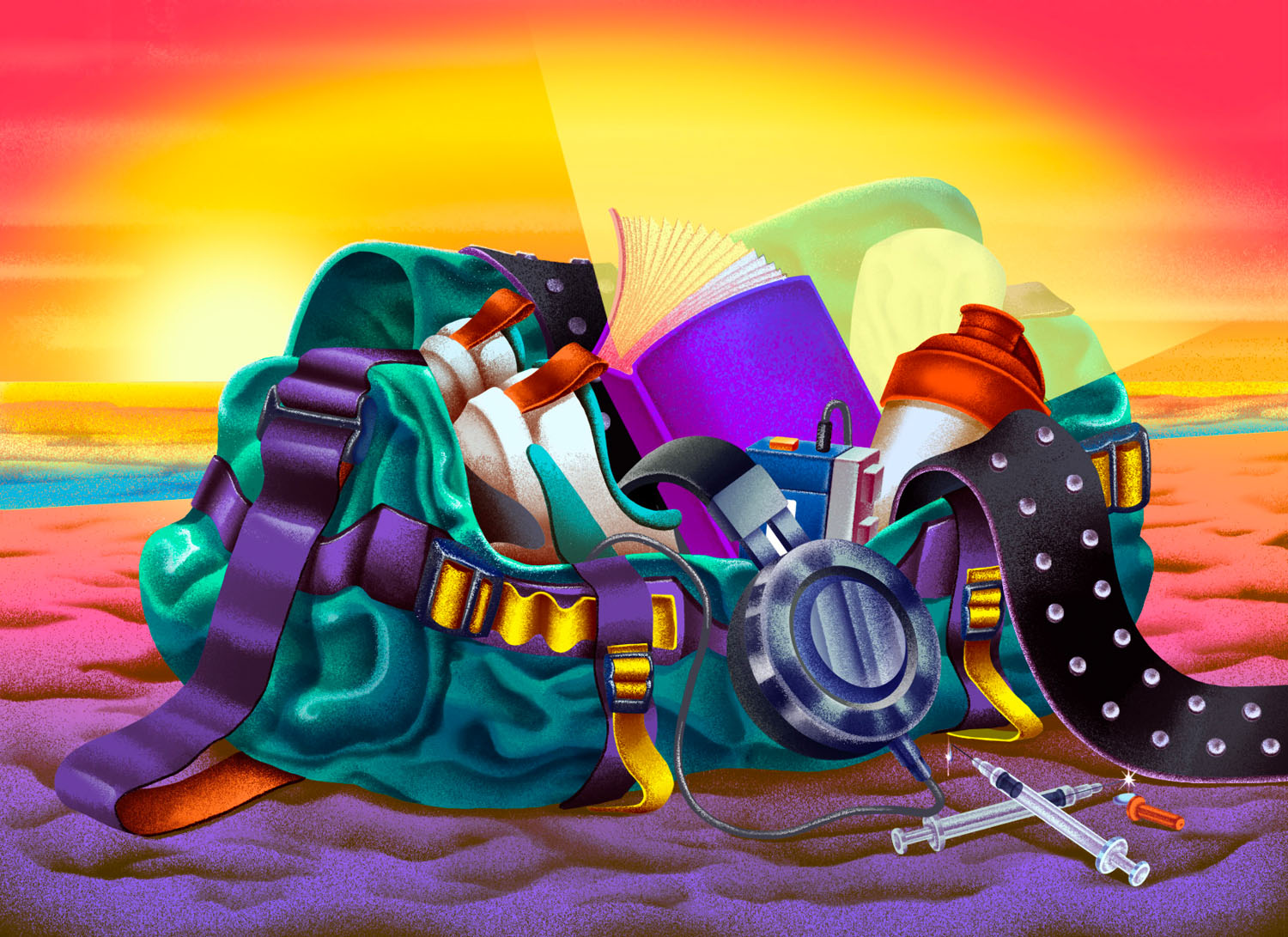
So I was strutting up 17 toward the gym, damp and shirtless and bronzed, a little duffle bag at my side, my shorts not really shorts but little Lycra things to blow your nose with, mint green. We were bodybuilders, and I had to get to the gym before Damo was done. He had my drugs, and I was very concerned lest he take them all himself.
The cars were clotted both ways—Coolio thumping from a pickup, Skynyrd spilling like glass from a Corvette. Other music up ahead and behind, but I couldn’t tell what. Bikes everywhere were sawing the afternoon air. That gasoline smell, the oil, the chrome. Drivers had exited their cars, resigned to this blockage. Some were having a jubilee right there on 17. Smoke from a charcoal grill plumed from someone’s open trunk; a kindly Floridian, not sober, was doling out hotdogs and something else that, judging by his sneaky hands, couldn’t have been legal.
The Atlantic was right there a block to my left. I could smell it on the breeze, and I understood right then that I’d wanted it my whole life. It smelled like promise.
These wondrous women in the van: They’d come up from Georgia for the bikers’ festival. There were six, maybe eight of them, I couldn’t tell. Vans have a particular musk in common, accented by whatever else goes on in there—weed, in this scenario, some coconut oil, a hint of shea butter, pear and mango shampoos. These women were maybe a decade or so older than me, all of them in one-piece swimsuits. I stretched out across their laps and I shut my eyes and let their hands slap and squeeze here and there as they laughed. Would you believe it if I said there was nothing at all erotic in this? Hair to heel, only grace, healing in a way. Even this name they’d given me, Baby Peaches, was a tonic all by itself.
“Baby Peaches, where’s your momma at?”
“We’ll keep Baby Peaches for our own selves, have us some of these muscles.”
What had I ever done to be blessed by this strange and random tenderness in the afternoon?
But Damo had my drugs and I needed to be at the gym. In eight weeks there’d be a bodybuilding show in Charleston, and I had to win it. I needed the money.
“Baby Peaches, don’t go!”
“We’ll drive you.”
“Lordy, these guns on this boy.”
Farewell, Georgian Angels.
I’d been at the beach for several months by this time, having fled the Jersey winter with a lanced heart. I’d had no place to live anymore in Jersey after my father booted me when his new girlfriend and her caravan of kids moved in. (The kids, he said, required my room; they postered my walls with T-Rexes.) So I left Jersey when I couldn’t spot other options. A powerlifter I knew at the gym in Brunswick said Myrtle Beach would remake me. That sounded like something.
In the early weeks at the beach I still carried the Rimbaud around in my duffel. I wanted to write poems like that, but I wasn’t a writer and didn’t know how to be. Alas, I carried the poetry but kept it hidden because the boys at the gym wouldn’t get it. It would’ve prompted cruelty a dozen different ways. And yet in their own sweaty aesthetic forms, in the symmetry and symphony of their physiques, the boys themselves were a kind of walking, posing poetry. You can bet I kept these parallels to myself.
The woman in Jersey I’d loved, she taught French at Kean. She’s the one who steered me toward Rimbaud. He was the one for me, she said. She chose me (that’s how she put it) when she caught me reading Keats on the stationary bike, after the paperback had fallen out of the muscle magazine I’d been using to hide it. And she chose me, too, for simpler reasons. I had a body-fat percentage near two percent; she said I looked like a diagram from Vesalius. I didn’t know who she meant, but I was emboldened by anything she said.
Now I was renting this first-floor studio on a golf course in North Myrtle Beach for an unbelievable three-fifty a month. Unbelievable now; in ’94, it was all I could do. Manning the front desk at the gym, mopping the sweat and stink, peddling T-shirts, blending protein shakes for the boys: It covered my rent but not much else.
I’d started buying steroids in bulk from Damo and then reselling them to the boys for a profit. But I was out now. Damo had flown back from Mexico City just the day before; he’d packed the ampules, vials, and syringes inside six medium teddy bears. Had a carry-on crammed with nothing but these bears. If it had been sniffed out by dogs, what would he have said? How do you explain away something like that?
If I could get my hands on the drugs, I had a chance in that competition. If not, a chance—any chance, it seemed—wouldn’t come again anytime soon.
When I got to the gym, I found Damo there punching it out with a guy called Ray Butch. The parking lot wasn’t a large one; maybe ten cars could fit there. Damo and Ray Butch were in the center of it with their shirts ripped off and their muscles out, blood stringing from their noses.
You could see this easily from 17, and the revelers stymied by traffic were now standing outside their Chevys and Fords, some perched on hoods and roofs, all of them yelling and cheering. Some, it seemed, were taking bets. Damo and Ray Butch kept battering one another, sweating and bleeding. I could not comprehend why the boys hadn’t put a stop to this.
Only Sarvey was there. Sarvey was my closest confederate at the beach, but I didn’t want him to be. He told me that he’d never had a Yankee for a friend and then hooked himself to me and would not unhook. There was a daughter and an ex-wife somewhere in his backstory. Sarvey was from about as rural a batch of Carolina as you could hope to find—or not hope.
I never locked my place and would often return to discover him there—in my food, on my couch, on my toilet. He sauntered round half-naked more often than not, flexing in just about any mirror, or window, if he could make himself out in it. More than once he’d hand me the syringe and insist I inject his upper buttock, though we both knew he could do it himself. He sometimes spoke with such volume you could feel your hair shudder. At night, when the sprinklers wet the golf course, he’d hop out there and shower in them. A top-shelf pipe dreamer, he would one day plan to become a fighter pilot, the next day a fireman, the next a cruise ship captain.
“Why are they fighting like this?” I asked him.
Damo must have thrown out his shoulder, because he was now trying to combat Ray Butch with only one arm. Some of the bikers in traffic appeared to be altering their bets.
“Done stole Damo’s juice. Ray Butch did. The juice he juss got back from Mexico with.”
“What!”
“Yup. Broke into his place lass night. Done stole it all.”
“But some of that was mine,” I said.
“Lotsa boys been sayin’ that, beau.”
Sarvey called me “beau” for a reason I did not know. “Bro” I understood. “Beau” I did not. (Everyone I knew at the beach had at least five years on me. One guy called me “Peanut,” which I did not appreciate.) I cannot, now or ever, ask Sarvey why he called me “beau.” A tumor wiped him out the year before last; maybe the drugs we took were the reason. People from the beach, those who somehow still knew how to reach me out West, kept calling to ask if I might visit him before he was gone, just one last time, he’d like to see me. But I never called anyone back.
“Why are you the only one out here?” I asked him. “Where are all the boys?”
“Boys’re inside. Watchin’ OJ on the TV.”
“Watching what on the TV?”
“OJ Simpson. Done cut off his wife’s head. Her boyfriend’s too. Now he’s eludin’ law enforcement on the L.A. expressway. Not even haulin’ ass, juss cruisin’ along, ignorin’ ‘em.”
Through the gym’s many big windows I spotted the boys huddled beneath the suspended TV, as if stargazing. I saw our pal Rotan there in the corner on the seated leg extension, quarreling with his quads, which would not grow no matter what he needled into them. His grimace was what you might see on someone in gastric agony.
Bloody spittle was still stringing from both Damo and Ray Butch, whipping round their heads. One white car door looked like a Pollock.
“Sarvey, how long have they been at this? I’ve got to talk to Damo.”
“Not long.”
“The Charleston show’s in eight weeks. I need the Suzie and Winny.”
“Join the club, beau. Lotsa boys’ll be missin’ their Suzie and Winny.”
Suzie was Sustanon 250, a mass-building, oil-based injectable; Winny was Winstrol-V, a water-based steroid vets pumped into horses. We hit the Suzie in the off season to gain mass and then hit the Winny in contest season to get lean. But those weren’t all we hit.
“And the D-bol?” I said. “It’s gone too?”
“The D-bol too.”
“Don’t tell me the Drol.”
“The Drol too.”
“And the Test?”
“Test too. All of it. Ray Butch did it.”
I angled in to stop Damo and Ray Butch, but just as I did, Sarvey said to me, “By the way, beau. Made up my mind. Smokejumper.”
“Come again?”
“My vocation. It finally came to me. I’m gonna be a smokejumper.”
We were chemists, druggists, nutritionists, warped body artists. We made God look like a sociopath with shaky hands. Even Christ would’ve been disgusted. We were positively cycloptic, seeing drugs and iron and meat, smiting our days with vanity. We were carnival and carnivory. Working out, we smelled of onion and felony. We might have been improved by ministers, maybe witches. There were rumors out there that we drank gasoline and pissed blood. That was half true. People stared, stared, and we wanted them to. Scales and mirrors, tanning and hydrating, counting calories, measuring grams. Training with lunacy, dead lifts and squats that made us puke we pushed so hard. We broke laws—we had to. We schemed. We hurt others. I wanted to stop it but didn’t know how. This was us.
The precontest diet was a downright draconian affair, and I’d just started mine. Fifty grams of grilled chicken breast, three cups of steamed greens, eight-ounce boiled potato, or three cups of brown rice, and all of it every 2.5 hours. Not an atom of sugar—people think it’s fat, but sugar is the foe. We downed a gallon-plus of water a day: Train your body to rely on such water, and it won’t hold on to any. If you have water beneath the skin on contest day, forget it, you’re finished.
But in the off season, we ate and ate with scant discrimination; anything for mass. Our aim was eight-thousand calories daily: Unless you shock the body into growing, with a bombardment of food and weights and drugs, it simply will not. The body does not want to look as we made it look, but we never asked for its opinion.
What I wouldn’t sacrifice to have that physique again, to be so muscled beneath the Myrtle Beach heat with sixty years up ahead instead of these forty at my back.
We were parked in the night at an apartment complex on the water, the immense moon sitting dead-faced in the sky, glinting in the ripples of the bay. Sarvey sat at the wheel, Damo in the front with his arm in a sling, and myself there in the back, trying not to be convinced to burglarize. The three of us spent an unadvisable amount of time at the Dollhouse and the Crazy Horse, strip clubs on 17 that Sarvey insisted on calling “gentlemen’s clubs” because that’s what the signs said. The night before last, Sarvey had gone home with Raven. This happened on occasion but not often enough that you’d call them an item. He’d peeked when she hid her cash in a kitchen cabinet.
“Raven’s place is that one there, beau, far leff, second floor, see? I unlocked the slidin’ door this mornin’ when I leff. You’ll be unimpeded.”
Raven was her stage name. From Ohio. Nobody at the beach was actually from the beach. Once, at a pool at night, everyone alounge and pleasantly deflated from smoke, I tried to recite Poe to her and she said, “I can’t listen to that right now.”
“Tell me again how I got elected to do this.”
“Well, I can’t possibly do it,” Damo said, turning in his seat to present his sling. Both of his eyes had been blackened by Ray Butch; his lips looked axed in three places. A tooth was missing.
“And I’m the getaway driver,” Sarvey said. “That leaves you, beau.”
“I don’t feel right stealing from a working girl,” I said. “We don’t do that up north. There’s a code there. And anyway, I like Raven.”
“Come on now, beau.”
“She’s the only one there who uses my name. Everybody else calls me ‘Jersey Boy’ or Peanut…or Beau. Those aren’t manners.”
Savey turned in his seat and gave me an injured look.
“Listen, beau. She done stole all that cash. Spent about an hour with that ole fella in the champagne room lass night and she done come out with all that fella’s cash. Said he juss come off a plane from Vegas, had a suitcase of cash and was so drunk and old and rich he wouldn’t even miss it. So you ain’t stealin’ from no workin’ gal, beau. You stealin’ from that fella we don’t know.”
“So you want me to climb up to her balcony on the second floor?”
“It’s two floors, beau, not twenny. Where’s your esprit?”
“My what?”
“Esprit.”
“Please get goin’,” Damo said. “Please? My shoulder’s killin’ me.”
“And if she comes home while I’m in there? What then?”
“She ain’t comin’ home, beau. Them ladies don’t leave the gentlemen’s club till three or four, you know that. Now git.”
It wasn’t hard to hoist myself up to her balcony by standing on the iron railing of the one below it. I was in black from gloves to jeans and very worried that someone near the harbor would see me doing this. The news was chock-full of OJ and his bloody glove and this did not inspire me. Given the mayhem around here, I wouldn’t have drawn a glance if I was simply climbing the walls in my underwear. I’d overthought it. But it was too late to change now. The moon winked in the water. I begged forgiveness in whispers and could hear only my own pulse pumping in my ears.
The sliding door was unlocked, just as Sarvey had said it would be. And right away Raven’s moonlit apartment socked me in the chest—the cleanliness of it, the order, the matching white-and-black décor. Scents of vanilla candle, lavender laundry detergent, a subtle perfume whose scent defied naming. Not a dish on the counter or in the sink. Towels folded with symmetrical care.
And on the far wall a crucifix chastising my every pant. Now I had this to deal with. Christ might have turned over tables in the temple and, on an off day, told devotees to take up a sword, but he did not rob working girls.
It was Raven’s bedroom that made me the most regretful. It was as orderly as every other room, a bed made mathematically, a family of faces framed on her bureau, a white carpet vacuumed into boulevards. The sheer responsibility of her place shamed me more than my being there.
I folded down the top corner of her fluffed duvet on the side she slept on, and on my knees pressed my nose to the slight dent her body made nightly in the mattress. I felt heavily embarrassed. I could smell her there, the clean sweat from her sleep.
The cash was there where Sarvey said it would be, in a kitchen cabinet, wrapped, for reasons only Martians knew, in tinfoil. Dense stacks of twenties and fifties: There must have been twenty grand there. I slipped a fifty into my pants to feed myself and left the rest.
“The money isn’t there,” I told them, back in the car. “Kitchen cabinet had only a dish in it.”
“Did you look round elsewhere?” Sarvey said. “Maybe she moved it.”
“No I did not look round elsewhere. You can go up and look round elsewhere. It’s not there.”
“Why’re your eyes like that?” Damo said.
“Like what?”
“Are you crying?”
I looked out at the harbor; the moon was gone.
“Man,” Damo said, “I knew this wouldn’t work.”
Damo was special among us. He could play piano, guitar, harmonica, write songs, sing in key. He was so massively muscled that the guitar looked like a ukulele on him. His legs were brontosaurian. He didn’t walk—he waddled. Blond enough to be a beach idol, he suntanned in a banana hammock, his bulge like a soda bottle.
Such misfortunes had found him. His biological father was a German musician who’d spent just a night with his mother. She was accidentally killed by an ex-con boyfriend when Damo was nine—something to do with a pickup truck in a driveway. The foster home in Louisiana? Exactly what you’d expect from a foster home in Louisiana.
Like some others there whose options were scant, Damo joined the army, the 82nd Airborne in Fayetteville, North Carolina, after high school. Two years later non-Hodgkin’s lymphoma bit into him, forcing a medical discharge. He beat up the cancer at Duke University and came to the beach to open a tanning salon that didn’t get customers, then a mobile snow cone business, some of those little pushcarts up and down the beach, but there weren’t any customers for those either.
He was half-content to mooch off his girlfriend, Mazie, for a while, chasing a record deal to become the next Prince, albeit a blond one with a surreal physique. All of us from the gym, women and men both, often gathered on the sand behind the Spanish Galleon at about midday. The Galleon was the nightclub where we lost and found each other four nights a week. Booze is catabolic and so not a bodybuilder’s friend, but we made certain allowances for the aches in us. Sometimes we’d have a ruck of twelve, fifteen of us in little shorts and nothing else. When normal people passed, they stopped to gawk and wonder at the sins of evolution. Some clicked their Canons. Coeds inebriated at noon or pure families with astonished dogs gone silent would wonder what made us, what firmament we’d fallen from. Some swooned. Others sneered at what we’d tortured ourselves into. Once, a wrinkled woman aimed her rosary to ward us off.
In the day, before my shift at the gym from three to nine, I’d sometimes come off the beach at the Galleon and onto Damo’s back deck, sirened there by his falsetto, his fingers working the keys. It didn’t look right and he knew it, such roided bulk at a piano. Some of us have the curse of incongruity; some others turn it into a blessing. Elton John and Prince were his heroes, though the pair had nothing in common but flamboyance, and although Damo could sing like both, he didn’t have the aura of either. Once or twice we penned lyrics together, saccharine ditties without hope. I’d steam chicken breast, broccoli, and brown rice in his kitchen while he played and sang, grateful I had no ambitions beyond looking freakish with muscle.
On the large TV at Damo’s place was usually the same movie: Tombstone with Kurt Russell as Wyatt Earp and Val Kilmer as Doc Holliday. There are lines at the end of the film that Damo repeated in circumstances that did and did not warrant them. When Kilmer is dying in bed from consumption, he asks Russell what he’s wanted most in this world, and Russell says, “Just to live a normal life.” And Kilmer says, “There’s no normal life, Wyatt. There’s just life.”
These were, to the young men we were then, the saddest words ever spoken. We had such a steadfast affection for Kurt Russell and Val Kilmer in that film, and savored in the legends of Wyatt Earp and Doc Holliday. When Kilmer tells Russell to leave his bedside so that Russell does not have to witness his most reliable friend die—Russell says, “Thanks for always being there, Doc”—he dies. Damo and I would go silent for five, six minutes, letting the credits scroll.
He made cassette tapes of his songs and mailed them off to record companies in California. When they didn’t respond, his breath would get erratic and his face would morph into a mask of disgruntled worry. I thought part of the problem might be that there was a shirtless photo of himself on the cassette tapes he sent. They looked like little romance novels except that it wasn’t Fabio, it was Damo. The music wasn’t bad, by late ’80s standards, which were the only standards Damo had, the late ’80s being his time. No, it was the muscles that wrecked it. That’s why he never performed at the clubs around the beach and thus did not have a following: He knew what an absurd sight he made for a musician.
But for a bodybuilder? He’d been blessed with cosmic DNA, genetics so ripe for muscle he could have gone pro and been remembered as a champion. But that’s not what he wanted. What he wanted, of course, was precisely what he could not have.
And that is the great tragedy of life as “just life”: not that we die and return to dirt, but that the world grants our enjoyment and denies our joy.
We were ambling back from the Spanish Galleon at nine at night, wanting to bake a loaf of bread, our plans of revelry having failed. The beach was oddly abandoned; the only ones in the Galleon were a three-man band making maladroit noises in a corner too dark to see them in. We couldn’t find our friends. Then, beneath a sky that looked as if it had wicked things on its mind, we heard from behind us on Ocean Boulevard: “Hey, boys. Where’s the party?”
And there, in a two-door Dodge with North Carolina plates, were our sisters, two women to match us: one blond, one brunette. They were eagerly hunched forward and talking at us through the window. But what they were talking was a tongue I had not heard before.
We stopped and then looked. Damo turned to me and then Damo turned back to them. “Party?” he said. “Our place?”
“Sounds great,” this driver said, the blond, and Damo pointed her to the corner of Eighth Avenue.
“What’s happening right now?” I asked.
“Looks like them girls came to the beach tonight for a party.”
“What are we going to do?”
“Give ‘em a party, I guess.”
I’d been at the beach only a few months at this time and was not yet fully privy to its bacchic rhythms and the extent to which this stuff not only happened but would not stop happening.
The trunk of their car was a veritable saloon; they traveled with supplies. The blond attached to Damo and I guessed the brunette liked me. She was squeezing my pecs and delts as if to test if they were real. They would not tell us their names. “What’s in a name?” the brunette said, and so I’d begun thinking of her as Juliet.
Once inside she cut lines of blow on the kitchen countertop with her driver’s license, then inhaled two of them and a shot of something. Then they asked us to undress and flex, and we obliged, and then they asked it again. We gave them the show they’d come for, poses we perform onstage during competitions. They wanted us to rub our bodies together and for some reason we did that. I wasn’t in charge here; I don’t think even these women were in charge. I blame it on some ill wind that had just blown through the beach. They clapped; one of them squealed. The blonde kept saying to Juliet, “Can you believe our luck?”
Luck: where had she ever heard a word such as that?
We had to have them out before Mazie got home around dawn. There was time to drink more, and soon they were stripping too, down to panties and bras, making their own poses in playful mockery of us. I didn’t mind this mockery and couldn’t say much.
Then Damo, 98 percent disrobed, went to the keyboard and played the—let’s all agree on this—the subliterate ditty “Candle in the Wind.” But I loved to hear him play it; he was able to make the lyrics sound less ridiculous, something in his voice. I couldn’t name it but knew it was kin to dignity. Done with that, he grabbed the acoustic Gibson to do “Every Rose Has Its Thorn” because he knew I had a maudlin weakness for that song—he winked at me and I loved him for that. Whenever he picked up the Gibson he had his usual repertoire, beginning with Richard Marx’s “Right Here Waiting” and Prince’s “Purple Rain,” and he played both that night. I was afraid those girls wouldn’t listen—I kept giving them worried glances—but I believed they did. I believed they listened and liked it. I wanted that belief. They stared and stared, though not at what we were used to being stared at for.
After the songs were done, Juliet tugged me upstairs, and the blond led Damo to the dark down the hall. Everything was smooth and right, and I wanted it to go on but it couldn’t. It was nearly four a.m. now. Juliet wouldn’t give me her number. When I asked if I could see her again, her lower face showed the slight trembling of an almost-smile. “I’m too old for you, sugar,” she said, and pinched my cheek. Then Damo and I watched there in the driveway, hands in our shorts, as they went off into the Myrtle Beach murk.
After a solemn minute, Damo said, “Were they laughin’ at me?”
“Huh?”
“Those girls. Were they laughin’ at me?”
“When?”
“When I was playin’ songs. When I was singin’ in there. I think they were laughin’ at me.”
“No,” I said. “They weren’t laughing at you.”
“You sure?”
“I’m sure of it,” I said, unsure. “I promise. Why would they?”
He wavered there in his driveway.
“Come on,” he said finally, “help me clean up.”
I did the cleaning. He just stood there over his keyboard, looking at it as if it might solve a riddle he’d long been living with. Every now and then he’d play a chord that sounded familiar, from a song we all knew, though I couldn’t place it. He didn’t add another, or flow into any song. Just that chord. I hear it now like a faraway bell, though I still don’t know what it goes to.
Often at dawn I’d walk home a mile up the beach from Damo’s place. Like the previous night when the North Carolina pair had come upon us, the beach was bizarrely vacant now, hushed but for the surf. The rim of the Atlantic was just then shading into a sherbert bruise, the black waves bluing, and there were no joggers to interrupt it, no oldsters leashed to dogs, no yogis forcing those poses upon themselves, not even the still-drunk straggler who’d dropped his keys and his shame. Nobody a mile to the right, a mile to the left.
There was just a single person I could see in the blooming light, a guy about a hundred yards ahead of me at the lip of the surf, shirtless and sitting cross-legged in shorts. And I was confused because even at that distance, in that light, I knew there was only one guy at the beach who had a back that developed, lats like wings, traps like hills, such striated rhomboids, the lovely mass and symmetry of it.
But it couldn’t have been him because I’d only twenty minutes ago left him at his condo sitting forlorn at the keyboard. I doubt he could’ve sprinted here. He had the wrong legs for that. Damo followed the old bodybuilding adage: If you want to look like a runner, run. If you want to look like a lifter, lift.
As I approached him, I could see the sun hanging there above his head. He lifted his arms as if to press a barbell, and from the angle I had, it looked as if he was lifting the dawn, propping up the sky.
I sat beside him and saw his eyes were pinched shut, his golden hue oddly blanched, his golden hair somehow not quite golden. His face was his face but also not, something in it off, tilted, tweaked. And he continued to lift the sun. I said his name and he said nothing.
“What are you doing, man? How did you get here before me?”
Like his face, his voice was his voice but also not. He wouldn’t open his eyes, and I had a Greek thought then, a thought I could not explain at the time and cannot explain now. I thought: Someone has scooped out his eyes.
“Damo, what in the hell are you doing?”
I looked out onto the Atlantic, at the sun in Damo’s hands, and then back at him. He would not open his eyes or lower his arms.
“Damo, would you look at me a sec?”
Not a phrase, not a word, nada. I hadn’t slept in two days or more, and this exhaustion hit me now. I could feel myself tilting back and forth as if I was on the sea. I wish now that I’d had more patience in that moment, but the silence and the business with the arms was too inscrutable, and made two days without sleep feel like a week. I was spent.
“See ya, man,” I said finally. “I’ll call you later, I guess.”
I walked on—he was definitely finished with me—and about thirty yards up the beach, I turned back to see him and he was only a smudge, almost a mist, and I knew then I needed to sleep.
I was groaning with hunger when I had to stop home to palm the only money in the world I had left, a twenty on the table and a five in my jeans. Juliet had snatched my wallet, which, as infuriating as it was, seemed a proper comeuppance for the fifty I’d stolen from Raven the week before. I guessed that the blond had taken Damo’s wallet too.
I walked into a little breakfast joint we liked and really got down to it: pancakes, eggs (runny), grits, ham. I had to stare at the clean plate and think hard about what little cash I had left to stop from ordering more. OJ’s doleful mugshot was up on the TV behind the counter, frowning between two heads debating it, though I couldn’t hear anything. I looked again at the plate. This wasn’t anywhere close to my precontest diet, but it didn’t matter now because there would be no contest. Ray Butch had all of our drugs but wouldn’t admit it, and wouldn’t sell anything to me when I asked. Selling would basically have been a confession. The Charleston contest was impossible now. I’d end up writing my father for money. All I got was a C-note with his scrawl on the bank receipt: “No worky, no turkey. No money, no honey.” That would be the last bit of his wisdom and charity. In a year he’d be dead, felled by a faulty heart.
After breakfast that morning, I tried dialing Damo to see if he’d returned from the sand, and if the blond had snatched his wallet as Juliet had snatched mine, but he didn’t pick up. And then I slept the sleep of the destitute, layered dreams of unearthing treasures on the shore—only to have them evaporate in my hands, over and over again. I awakened irritated.
I lay there thinking a while of whom I could contact for a loan. It was near dinnertime when the phone jolted me out of this trance. I knew it was Sarvey, somehow, and just let it ring, trying to wait him out. But Sarvey wouldn’t stop ringing.
When I finally picked up, he said, “Beau. Beau, you better get you on over to Damo’s place. I’m at the gas station a block up. I’ll meet you there.” There was something in his voice I hadn’t heard before and knew I didn’t like.
The story was that Mazie had returned just after dawn from the club, maybe twenty minutes after I’d gone. Damo was there in bed, sleeping the way he did, belly-down. She didn’t think to check his breathing. Why would she have? After six hours of surrendering to rakes and cads, all she wanted was a shower and sleep. She woke around four that afternoon and found him cold. There was chatter of overdose—cocaine, alcohol, steroids, Xanax, lethal amounts, careless hedonism. But I knew him, and I knew it wasn’t any of that. He was a friend of mine. He was thirty-one.
As Sarvey and I watched the medics wheel him into an ambulance, I could see just a sprout of his blond hair from under the sheet. I see it still, as clear as the dawn itself.
I kept on at the beach for maybe a month more after that, but bodybuilding was finished with me. It wasn’t a decision; it just dissolved. Sarvey went into the timeshare racket, and when I was ready to leave, he didn’t try to convince me not to.
Soon I was out in Colorado, carless, giving college a try with federal aid I would never be capable of repaying. When the muscles gave out, Rimbaud and the others looked less ridiculous with me. I began reading more, living less. I couldn’t get back to Jersey for my father’s funeral; I had nothing to buy the flight with. I tried to find my mother but couldn’t. She was determined never to be found. I think I understood.
In all the years I’ve been here, I see Damo still, usually on Pearl Street in Boulder. I am surprised by how many of the dudes here resemble him, a vague itinerant aspect about them, a little unwashed, his same physique but softer, older, blond hair past the shoulders now. And if any one of these clones is playing guitar, on the plaza or in a bar, I can tell I make them nervous with how intently I stand there and listen. I dreamed that one of these guys was, finally, him. I told him all I ever wanted was a normal life. There is no normal life, Damo said, just life.
All that youthful motion we had exhausts me in recollection. Living, some call it, but it was only moving, fleeing something in hope of finding something else, something we couldn’t name then and cannot see now. Residing in these rocky woods, alone, I rarely worry about what is beyond them, but sometimes, as the sun dies behind the trees, I can feel the possibility of something waiting. In that gloaming, as I rummage around for names, and as I name the dead, I don’t move. If I keep very still, I can see everybody again.

Dani Choi is a South Korean–born illustrator whose work has appeared in The New York Times, The New Yorker, and Poetry. She has won two New Talent World Illustration Awards from the Association of Illustrators, including selection as an Overall Winner in 2021.