Image

If you grew up in the 1980s, you know Scary Stories to Tell in the Dark. You remember the book being passed around like contraband during recess, smuggled from backpack to backpack to bedroom where you’d read it, if brave, at night by flashlight. You remember stories that were frightening enough for their merciless plots full of doomed teenagers and vengeful spirits; but, when paired with Stephen Gammell’s veined illustrations of black-and-white netherworlds populated by ghouls that hovered like ghastly balloons over the text, this book became the stuff of legend. Children loved it. Meanwhile, there was no shortage of adults drunk on Tipper Gore–style heroics who conspired to keep kids safe from this kind of fun—or, as they framed it, “the occult,” “satanism,” and “cannibalism” (all while championing other grown-ups who courted nuclear war and ignored AIDS).
Given all this controversy, it’s no surprise that the American Library Association named Scary Stories to Tell in the Dark the most frequently “challenged” book of the 1990s, and it has reliably ranked in the top ten since. Why? Because this book is awesome. Because it offers a safe, specific place for us to understand our fears. Because it asks that we think not just about the stories themselves, but the pasts they arrive from and the futures they promise if we become so bold as to forget that the stories we tell to scare ourselves will never be as terrifying as the realities they spring from.
Wherein a poor girl buys a prom dress from a secondhand clothing store not knowing the dress was stolen from a mortuary and is laced with the formaldehyde that will kill her once she absorbs it through her skin.
In the late 1980s, Corona Extra—la cerveza más fina—was rumored to contain a special ingredient: urine. This was, of course, untrue, but the rumor spread quickly thanks to a jealous rival (allegedly a Nevada-based Heineken distributor) giving a xenophobic public something to stew over. The idea was simple: Mexican workers were getting back at gringo imperialists by sending them their piss to drink. Though inherently ridiculous, this urban legend struck a narrative nerve—infection, invasion, nationalism—and Corona saw their sales tank. Ten years later, Tommy Hilfiger suffered a similar fate when, at the height of his brand’s popularity, he appeared on The Oprah Winfrey Show and stated, “If I had known Black people would buy my clothes, I would not have made them so nice.” This, too, never happened. But it tapped into a cultural expectation—rich, preppy, WASP designer of overpriced polos and chinos denigrates customers of color—and sales took a hit.
It has been suggested that “The White Satin Evening Gown” owes its existence to a bout of small-scale commercial warfare, some beef in which a clothing store didn’t like that another clothing store was getting all their business, so they manufactured a bit of hearsay to sink them. Perhaps. But in the version I prefer, which emphasizes the secondhand nature of the clothing in question, the story operates as a distinctly pro-consumerist, anti-recycling manifesto—a.k.a. BUY NEW OR ELSE.
Because the girl is poor, she must buy a used prom dress, and because she buys used, she cannot know what life the dress had before she acquired it. With this, we’re dealing with a haunted-house story, except that the dress is the house and what haunts it is poverty—which, when it comes to consumerism, might as well be death. Basically, the dress is no different than a can of soup that’s been damaged and left on a supermarket shelf. Sure, you can buy the soup on the cheap now that it has lost its hermetic seal, but you also have to accept the potential for food poisoning. It’s an imperfect metaphor. Dresses are not soup. You cannot dry clean soup. Nor can you put it in the washing machine. But you can launder a dress, so there should be no issue with the dress unless the story’s trifurcated criticism—(1) used clothes are dirty; (2) the dirt used clothes hold can kill you; and (3) used clothing stores do not clean the clothes they sell—holds true. The lesson being: If you buy secondhand goods, you may die.
This point is the perfect launchpad for the story’s absurd conceit—death by absorbed formaldehyde. Let me be clear: This could never happen (according to the CDC, skin contact would cause irritation at worst). But just as with Corona or Tommy Hilfiger, this possibility is ringed with a biased sense of probability, which makes it an imaginative truth along the lines of alligators in the sewer or that red bump on your cheek that turns out to contain thousands of baby spiders—it could never happen, but the mind can’t help but wonder, what if it did?
In any case, the girl—and it’s important that she’s a girl, because her gender is inextricably wound up in this puritanical Gordian knot1—must die for the sin of her poverty, as this is a story whose moral promises that safety can only be attained via the prophylactic powers of the American dollar. Safety, in this context, like America or currency, is really just an idea, but it’s our belief in ideas that forms the bedrock of any brand we trust,2 because brands have historically served as the thin red line between health and illness.
Take, for example, those brands that bloomed like boozy flowers from Prohibition’s drought: Owing to the glut of do-it-yourself distilleries (e.g., bathtub gin) that often included formaldehyde among their ingredients (the poison dress now the poison glass), ordering an established albeit much pricier beverage from the barkeep—a Cutty Sark, say, instead of a scotch from the well—was an investment in your future. You paid more, but you got to keep your eyesight—the difference, you could argue, being between a buzz and blindness. What we inherited from this—and what advertisers have ever since promoted—is a tacit understanding that generic products are more dangerous than brand-named, and that whatever injury we sustain in consuming them is our fault. Buyer, indeed, beware, for the shame will be yours just as it is for the mother in the story, who, in a pointed capitalist jab, unwittingly kills her daughter because she cannot afford to buy her a new dress. This perceived failure of parenting—the failure to provide quality goods—is what is fundamentally punished, resulting in a one-two Reaganomic punch that ensures this story’s appeal for the entire nuclear family by tapping into that most powerful of parental reflexes—guilt!—and most painful of childhood realities: consequence.
Yet there’s one more thing. Beyond the poverty, beyond the shame and guilt it carries, this is a story about how we use clothes as violence. Status, sports teams, gang colors, smallpox transmission: We have a history of weaponizing our wardrobes. In the Old West, you’d wear your riches to show you were a serious person. Now athleisure reveals who’s really part of the leisure class. And in our increasingly opinionated and cloistered society, the printed T-shirt makes a billboard of our bodies.
Last summer, at Dollywood, I was eating lunch in a 1950s-style diner with my family when a woman, hacking convulsively as she pushed her walker toward the exit, caught my eye. She wore an oversized T-shirt that proclaimed in bold letters vaccinated by the blood of jesus christ. This would not be the last of the XXL statement pieces I’d see that day, but it was the most memorable, a succinct articulation of the secular-versus-spiritual clusterfuck science has become for some in this country, not to mention why language feels so fraught these days. And, as I watched a few people take surreptitious photos of her while she shuffled morbidly out of sight, I felt she wasn’t so much a tragedy but the martyr of a tragedy. So desperately ill, yet, according to her T-shirt, so full of pride—pride being the one thing Americans seem intent on dying for no matter the viral wind they inherit (or disperse) as a result. So on she shuffled and coughed with her pride intact, all while her tunic of Nessus broadcast the psychology that betrayed her and so many others.

Wherein a teenage babysitter receives numerous creepy telephone calls revealed to be coming from a stranger upstairs.
Horror depends on two things: knowledge held and knowledge withheld. Think of any scary movie—say, Halloween: We know that the person dressed as a ghost standing before Lynda isn’t Lynda’s boyfriend, Bob, but Michael Myers, who has just killed Bob downstairs. But Lynda doesn’t know this. She thinks it’s Bob. So, as she flirts, we cringe, because we know what she doesn’t; and since we can’t warn her, we are complicit in her demise, simultaneously repelled and excited by our culpability (whether we acknowledge it or not, we are conspiring with Michael Myers to kill Lynda)—so much so that when the murder happens, we experience a catharsis akin to forgiveness. This is part of what makes Lynda’s proleptic situation so tragic: Screenwriter, director, and audience alike demand that she die to atone for their sin of wanting her dead.
Further twisting the proverbial knife for Lynda is her misunderstanding. So far as she knows, it’s Bob strangling her to death, meaning that while she dies horrified at his betrayal, we watch horrified by the truth only we possess. Knowledge withheld, knowledge held—which, at least for the first hundred years of its existence, was how the telephone operated.
Before the iPhone, before caller ID, before *69, before call blocking, the telephone was just a telephone—a hunk of wires held in a plastic shell that sat like a shapely coffin in your living room, waiting to ring. And when it did ring, who would be calling? You never knew, making the home telephone an aural bedsheet (is it Bob or Mr. Myers underneath?) as well as a vehicle for home invasion, only the violation wasn’t physical but psychological, not to mention your fault because, by picking up, you invited them in.
“The Babysitter” takes this notion and amplifies it by making the invasion two-fold: The psychological has become physical—the intruder’s voice, thought to be disembodied, is thoroughly embodied and well within striking distance. Though it’s impossible, just like dying of dermal formaldehyde exposure, this telephonic domestic infection works because we want it to work. Otherwise, the shock ending—THE CALL IS COMING FROM UPSTAIRS—would not be possible. The horror here is in the realization. The intruder was upstairs the whole time, and his omnipresence is a metaphor for how the circuitry of our increasingly technological world has infected the circuitry of our families. Such tales of telecommunicative Trojan horses would eventually move away from the telephone and to the television before moving back to the phone once the phone became, thanks to the internet, a television.3
Regardless of medium, what “The Babysitter” reveals is that we fear communication, especially when it arrives thanks to a device that will break down hierarchies that have long allowed for familial and national myths to thrive. What we fear is technology’s dissemination of the normal in favor of the strange, the new, the foreign, and unexpected. This fear of progress is one that I, half-hearted Luddite that I am, know well. If America can be summed up as an industry bent on constant invention, then equally constant is Americans’ resistance to inventions. From the cotton gin to the motor car to Napster, we tend to run from what’s on the horizon only to embrace it wholeheartedly once it arrives (not to mention once we figure out how to monetize it). The ax-wielding fury that greeted the telephone was no different. In “Time and Distance Overcome,” Eula Biss writes, “Property owners in Red Bank, New Jersey, threatened to tar and feather the workers putting up telephone poles. A judge granted a group of home owners an injunction to prevent the telephone company from erecting any new poles. Another judge found that a man who had cut down a pole because it was ‘obnoxious’ was not guilty of malicious mischief.” Yet such animosity didn’t last because, as we know from experience, everything new or strange will, given time, become so normal, so commonplace that we don’t even notice it. Like telephone poles. Or telephones and the strangers they make us to each other.
Wherein a couple on a date parks in a lovers’ lane to do what lovers do and narrowly avoids death at the hands of a hook-handed convict by not doing what lovers do.
In 1990s Salt Lake City, there were two prime poles for teenagers looking to park so they could make out. The first was Ensign Peak, perched right above the capitol building, whose slopes had not yet been developed and whose notoriety as a parking spot meant that it was oppressively crowded and the site of many a practical joke (banana, tailpipe). The second was twenty miles south in Draper, now an active suburb midway between the capital city and Provo, but back then a playground of yet-to-be-realized property development—labyrinthine networks of fresh roads unlined by houses, not a ghost town but the ghost of a future town where I spent certain evenings fogging up rear windows4 and fearing the boogeyman, for good reason: Draper looked out over the Utah State Prison, whose inmates—including Ted Bundy, Gary Gilmore, Ron Lafferty, and the Hi-Fi Killers, Dale Selby Pierre and William Andrews—were legion. So close to such a place, it was easy to imagine who might be crawling up those hills and what they might want from two teenagers in a parked car. But still, we went. Still, we parked.
The genius of “The Hook” is the simplicity of its hook, the way it harnesses the puritanical death drive that powers our prurience. And, in thinking of how most scary stories are fueled by an impossible imaginative truth, this story is completely believable, so much so that it has been sold for decades as a verified truth. In a 1960 Dear Abby column published in the Orlando Evening Star, a reader named Jeanette stated, “If you are interested in teenagers, you will print this story. I don’t know whether it’s true or not, but it doesn’t matter because it served its purpose on me…I don’t think I will ever park to make out as long as I live. I hope this does the same for other kids.”
In this, two things are revealed: (1) Never say never, Jeanette; and (2) The truth doesn’t matter so long as the lesson is learned. The latter point strikes at the very heart of faith, not to mention any exclusionary political or social narrative that relies on gossip to justify everything from the stripping of voting rights to genocide—all that matters is if we believe, because if we do, then, like Antonio Sabato Jr.’s belief about President Obama’s religion or the congestive woman in Dollywood’s belief in the transformative powers of Jesus, we can embody our faith through our actions, thereby making what had been impossible true. That said, Jeanette wasn’t entirely wrong, as in some cases—most notably the Texarkana Moonlight Murders as well as the Son of Sam and Zodiac killings (whose architects also took a newspaper-centric approach to ominous threats)—lovers’ lanes were sites of real-world violence, which places this story at the crossroads of the imagined fantastic and the actual horrific as it illustrates the two similar yet oppositional forces at play in the car—namely, survival: the survival of the species versus the survival of the self.
Like the famous slasher-film rule about virginity and victimhood, sex and death are locked in a symbiotic karmic loop. Wherever pleasure lurks, so too does punishment, especially for the young. Whether we’re talking star-crossed lovers in 1450s Verona or 1950s America, there’s always a skull grinning in the background, reminding us that these youthful forays into passion are haunted by the psychosocial and psychosexual expectations we have for youthful passion—that it will, inevitably, die. The J. Frank Wilson & the Cavaliers version of “Last Kiss,” legendary in its depiction of doomed yet eternal teenage love, comes immediately to mind, though it owes its epiphanic verses (“I held her close/I kissed her our last kiss/I knew I’d found the love I would miss”) to earlier blues recordings, specifically Son House’s “Death Letter Blues” (“It looked like ten thousand people/standing around the burial ground/I didn’t know that I loved her/until they began to let her down”). But whether in story or song, these fictional physical deaths refer to the death of love. Perhaps we scare our children because we want them to understand just how fleeting innocence is, or what consequence their hormones can lead to, but in doing so we also preserve the fears handed down to us as children, further promoting a set of assumed truths (or comfortable falsehoods) in the name of “tradition,” that most benevolent of monikers for the strictures society has taught us to suffer under.
Like the famous slasher-film rule about virginity and victimhood, sex and death are locked in a symbiotic karmic loop. Wherever pleasure lurks, so too does punishment, especially for the young.
Back in the story, the boy, eager to keep romantic potential alive, writes off the fatal possibilities of what’s scratching on the car’s exterior, but the girl knows it could be the hookman.5 The lovers’ lane looks right out over the prison frosted with razor wire, its searchlights waving in the night like a drowning man’s arms. Sure, the doors are locked, but what’s a window to a hook? A simple smash-and-grab and both kids are as good as trout. But what about us? the boy asks. How will we ever get this chance back? Yes, what about us? his date counters, and perhaps the boy then realizes that the male condition is being willing to die for sex while ignoring that women are killed for it every day. If he were older, wiser, more philosophical, he might realize his is the ultimate entitlement, that with the promise of sex, even the threat of death is not real, not to him. Jonathan Glazer’s Under the Skin inverted this reality to disturbing effect by depicting how men, when led by a beautiful woman into what is clearly a murder house, won’t even pause to consider the reality of their situation because they understand implicitly that when it comes to heterosexual relationships, they’re predators, not prey (one has to wonder how much more effective high school sex ed would be if this understanding was taken at face value). However, in “The Hook,” fear wins—the boy acquiesces and love licks its wounds in silence on the drive home. But here comes the kicker: In one last chivalrous stab at a second date, the boy goes around to open the passenger door and discovers a hook lodged in it. Death, it is revealed, was avoided only by the sublimation of desire.
So, what is the hook? The hook is sex, pregnancy, an STI, or reputational damage. But the hook is also a hook—something that will pull you from one level of existence to another: from virginity to congress, from life to death. In this, “The Hook” is inhuman in its obsession with keeping youth apart and afraid, and its fiction sticks precisely because it, unlike any number of soberly presented sex ed classes, doesn’t appeal to reason but fear, lighting the amygdala up with dread, the same amygdala that, according to a study in the Journal of Neurology, Neurosurgery & Psychiatry, lights up when exposed to the “viewing of sexual stimuli” but shuts down when it comes to “consummatory sexual behavior.” In other words, just when coitus should be relaxing the mind, the violently pornographic idea of the hookman illuminates it with fear—and what else but fear could cut through the heat and biological ache of teenage hormones, not to mention the question of consequence which lives in the momentarily dismissible future? Call the hookman the best abstinence imagination can buy, this phantom—both fictional and real—who, fixed forever in the present tense of our vehicular encounters, reminds us that the vulnerability love requires is not so different from the vulnerability death demands.
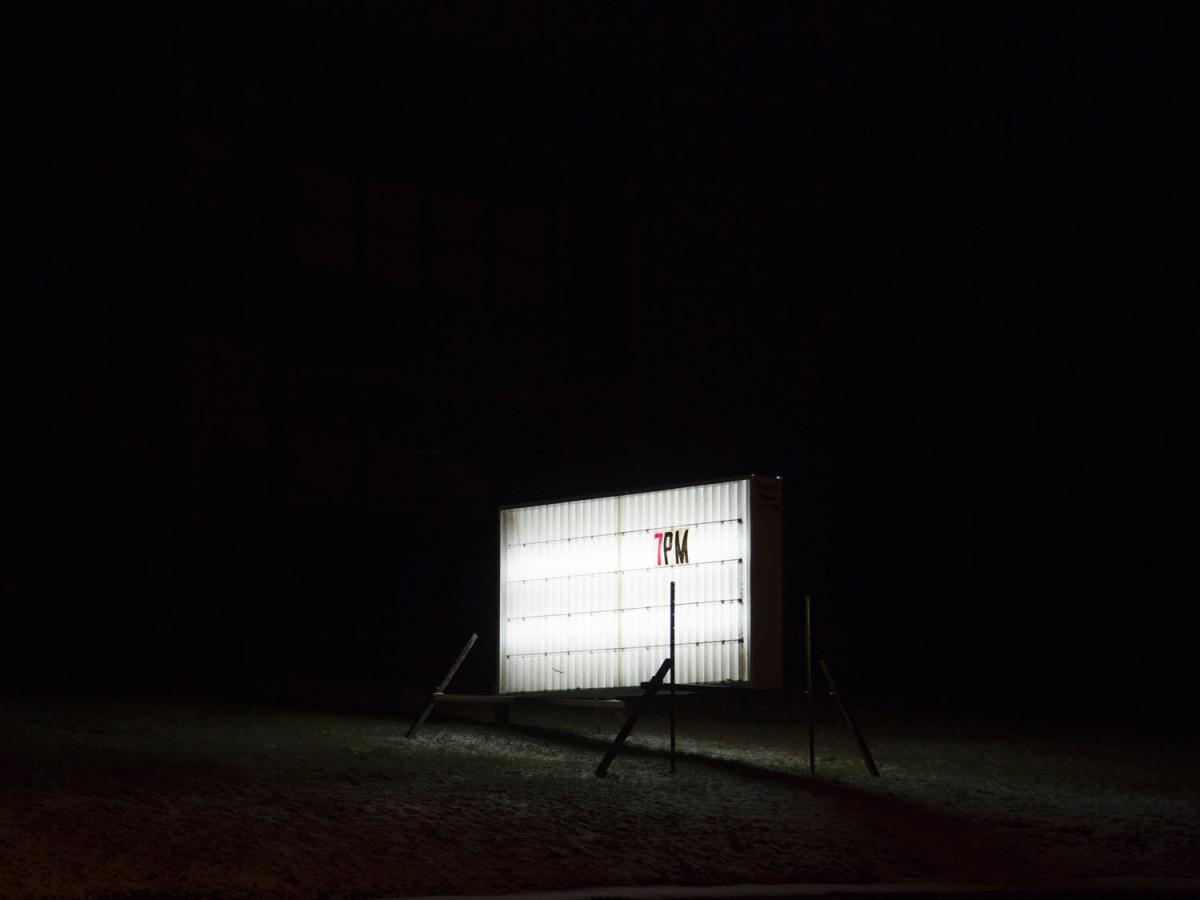
Wherein an old woman in an apartment building receives a series of ominous phone calls from a man who claims he’s “the viper” and will “be up soon” only to discover, after she’s called the police, that the man is a window wiper with a foreign accent.
When those you’ve long feared finally come for you, how will they arrive? And who will they be? The they in these situations depends on perspective, on culture: Consider that al-Qaeda to some is analogous to the Niña, Pinta, and Santa Maria for others (the clearest example of which was in post-9/11 America when the creation of the Department of Homeland Security was greeted with the proliferation of T-shirts bearing photographs of an armed Geronimo underneath which read HOMELAND SECURITY: FIGHTING TERRORISM SINCE 1492). Culture matters because the monsters we meet are often the monsters we make.6 Such is the case for the eponymous viper in “The Viper,” whose only crime is his accent, which allows him to be misunderstood—or, more accurately, understood by the old woman he’s informing of his arrival to be exactly who she believes him to be: a psycho killer with designs on her. And while this confusion is ultimately played for laughs (the ending offers a punchline—“I am the viper. I vish to vash and vipe the vindows”—rather than a conclusion—ICE disappearing the humble window cleaner under the belief that he’s some kind of international assassin) the story contains multitudes about how we not only enforce but also encourage the supernatural so that we can punish it.
But what is supernatural? Well, that which, etymologically speaking, goes beyond nature. Or, in society, that which goes against nature, and since a society’s dominant culture determines what is natural, that means anything that runs counter to said culture runs counter to nature, thereby making it foreign, unnatural, strange. This is why confusion is a hallmark of a supernatural encounter—the strange is, after all, strange—and while such a moment can result in wonder, such strangeness often enforces the misunderstandings we rely on to keep ourselves—and, by extension, our worldviews—safe.
When those you’ve long feared finally come for you, how will they arrive? And who will they be? The they in these situations depends on perspective, on culture. Culture matters because the monsters we meet are often the monsters we make.
Let’s put it this way: If a ghost is the past asking us to change the future, we can blame our unwillingness to act by claiming the past to be a ghost. The other is ignorable by design in that it exists not beyond the realm of our imagining, but beyond the scope of what we want to imagine. Anyone who’s ever lived in a major metropolitan city has already perfected this form of psychic jiujitsu—the urban directive to present yourself as present while still seemingly oblivious to the needs of the poor is a time-honored exercise in ethical Ferberizing.
Years ago in New York, I was on my way to work on a packed 1 train. Somewhere between 125th Street and 116th Street, a subliminal angst parted the crowd, and I found myself face-to-face with a man who had no face. Just a pair of wraparound shades over where he should have had a nose. His voice was a pneumatic whine, and around his neck he wore a laminated sign that explained who he was and what he needed. He had been the victim of an acid attack and needed money for reconstructive surgery. In that moment, the nature of his existence was so explicit that I and every other person in the car turned away in shamed silence, waiting for him to move on. His need was so evident, so colossal, that my mind retreated defensively into the impossibility of what he was asking for—how could he ever be made whole again? And how could I do anything about it? No money I could offer would help him. No money anyone in the car could offer would help him. He was a ghost—a livid ghost—alive beyond the means of our reckoning. In need of a miracle, he had the misfortune to find himself aboard a train full of apostates, othered not by his need but ours.
With this in mind, “The Viper” is fundamentally about how needs determine the order of our othering. What does the old woman—herself on the precipice of otherness thanks to her age—imagine when she hears the viper on the telephone? The barbarian finally arrived at her gate. And why? Because, whether real or imagined, barbarians justify the existence of the gate. The xenophobic kick of the viper’s supernatural nature is the result of many a trope (violent immigrant, accented villain) and his revelation as a kindly, hardworking man is also a trope, that of the smiling immigrant whose lack of fluency inspires an infantilized benevolence on our part. It’s not that he’s simple, it’s that we need him to be simple to preserve our “earned” superiority. It’s worth noting that his accent and lack of fluency are preexisting conditions that make him more likely to meet with arrest, incarceration, or death. In this story and in real life, otherness makes a person a target for the law as our police and legal systems have a longstanding tradition of taking advantage of “others” precisely because they cannot speak up or talk back or be heard—one only has to look so far as George Floyd uttering “I can’t breathe” in plain English to an English-speaking officer of the law to understand that this lack of understanding is as reflexive as it is pervasive, and has little to do with language and everything to do with who we think deserves language.
If we, like the old woman, fear the viper, it is because we fear ourselves (as Walt Kelly famously wrote in his Pogo comic strip, “We have met the enemy and he is us.”). As a nation, we want ambitious immigrants because they push our economy forward, but we don’t want them so ambitious that they threaten our place in the economic hegemony that our own ancestors upended. To fear the immigrant is to recognize the tenuousness of the beliefs and hopes that define what we refer to as the American dream. Now the joke may go that it’s called a dream because it doesn’t exist, but if you spend enough time in America and talk to enough people, you soon realize that the reason it’s called a dream is because anyone can have it. But, as in “The Viper,” whether you believe this will tell you something about who and what you listen to and who and what you want to hear when you do.
1 As anyone who’s ever attended a high-school prom knows, the binary is implicitly unfair: The boy’s parents can rent a tuxedo for a pittance compared to what the girl’s parents are expected to lay down for a new dress that she’ll wear, at most, once. Complicating this further is the notion of purity the new dress implies as these young women embark on a night that has historically been focused, if we’re to trust John Hughes’s filmography, on the loss of said purity.
2 Years ago, when working as a college guidebook editor for The Princeton Review, our publisher demanded that we come up with a new slogan. In response, I had my one and only moment of boardroom triumph when I suggested “The Most Trusted Name in Education,” itself ruthlessly plagiarized from CNN’s “The Most Trusted Name in News.” I say this without an ounce of ego: The publisher loved it. And they loved it even more when I pointed out that there was no way of disproving our bold claim because trust, like faith, is a feeling, and how could anyone challenge a person for how they felt? Critical thinking died quickly in that moment, just as it would continue to die over the coming years as the country leaned harder into feelings instead of facts. This phenomenon was crystallized for me by Antonio Sabato Jr., who, when interviewed by ABC News at the 2016 Republican National Convention, stated, “I don’t believe [Barack Obama] is a Christian. I don’t believe he follows the God that I love and the Jesus that I love.” When challenged as to why he believed Obama was a Muslim despite all evidence pointing otherwise, he said, “It’s in my heart, man.”
3 Particularly in the 1980s with films such as Videodrome, Halloween III: Season of the Witch, They Live, and especially
Poltergeist, in which the TV is a kidnapper that awakens the hippie-turned-yuppie parents to the evils of their consumerist ways by forcing them, in a Marxist twist, to save their children from their house, which ends up eating itself—what you might call a very creative reverse mortgage.
4 Given Utah’s famed religiosity, parking in my experience never meant sex, though it may have occasionally hovered near its threshold. As a self-conscious non-Mormon, I was more careful than my LDS peers whose dogmatic shackles demanded stunning acts of physical and lexicographical creativity: There was my mission-bound friend and his girlfriend, who claimed that anal sex was not intercourse, and there were also the legendary stories of BYU coeds who bookended weekends of “lawful” sex in Las Vegas with quickie weddings and even quicker annulments. Then there was the practice of “bagpiping,” which, for the sake of everyone’s dignity, will go unexplained.
5 Be it Beowulf or James Bond, physical disability or disfigurement has historically been equated with evil. This is, of course, a terrible trope, yet also a storied one. How many slasher films feature a villain whose anger stems from the disability or disfigurement that has removed him from the prospect of love? Consider that the masks our horror-film icons often wear aren’t for anonymity’s sake but vanity’s, and what we call rage on their part might indeed be shame.
6 In Men Explain Things to Me, Rebecca Solnit refers to an op-ed written by T.M. Luhrmann who “noted that when schizophrenics hear voices in India, they’re more likely to be told to clean the house, while Americans are more likely to be told to become violent.” Considering this, it’s striking how many Hollywood film protagonists are, fundamentally, schizophrenic. Whether we’re talking The Parallax View, The Conversation, The Manchurian Candidate, Blow Out, Total Recall, Enemy of the State, Conspiracy Theory, They Live, Arlington Road, The Truman Show, The Matrix, or a substantial chunk of Tom Cruise’s filmography, these films feature characters (always male) whose heroism is rooted in their paranoia, meaning that the stories we most often tell—and consume—feature a lone wolf bent on exposing some shadowy corporation or government entity for what it really is, a disturbing trope whose actions play out daily in America’s public spaces.
Anna Beeke is a photographer and videographer based in Los Angeles. She holds an MFA from the School of Visual Arts, a certificate in photojournalism from the International School of Photography, and BA in English from Oberlin College. Her first monograph, Sylvania, was published by Daylight Books in 2015...