Image

The SUV hurtled down US 89 a few miles north of Yellowstone National Park, headlights blazing through wintry Montana twilight. Elk clattered across the pavement on their daily rounds between the Yellowstone River and the adjacent hills, a timeless circuit the highway had severed. Brian Ertel sat in his car, parked in the driveway of his roadside home, and watched the glow brighten as the southbound SUV crested a rise in the highway that hid the elk, their dark forms silhouetted against the onrushing lights. Please see those elk, Ertel pleaded. Please see those elk.
The driver did not see the elk. The SUV pinballed off two animals and skidded to a halt. Ertel dashed to the vehicle and, through the shattered windshield, cut out the airbags with a pocketknife to reveal the shaken but unharmed driver. An ambulance arrived, along with highway patrollers and a passel of local high schoolers who set up cones and slowed traffic. The scene secure, Ertel turned to the elk. One was dead, the other mortally wounded. From his house Ertel retrieved his Remington and ended the animal’s suffering with a 150-grain bullet—copper, to avoid lead contamination. Then he dragged the elk to his garage, phoned a friend, and fetched his butchering knife. There was meat to salvage.
Ertel’s life had long been entwined with roadkill. A National Park Service biologist, he’d witnessed grisly crashes in Yellowstone, had even become an EMT after ministering to tourists who’d slammed into a bison. For years he and his wife, Hali Kirby, had hauled dead elk off US 89 and into gullies for the coyotes. Eventually they realized that they, too, could supplement their diets with scavenged meat. In 2019, Ertel took forty pounds off a bull elk killed by a white sedan and harvested another elk a year later. He made steaks from the choicest cuts, ground up hindquarters for burgers, tacos, pasta sauces. He all but ceased hunting. “It would just be excess that I don’t need,” he told me.
I include myself among the beneficiaries of his hobby: I’ve known Ertel for years and visited him a month after he’d butchered the latest elk struck outside his house. The creature had been hit in her chest and neck, leaving her back half untainted by bruising or bone shards. The steak that Ertel served me was cut from her backstrap, the loin that runs above the ribs and beside the spine, which he served rare alongside roasted veggies and crusty bread. The meat was sunset-pink in its center, closer in flavor to grass-fed beef than to venison. Chewing each rich morsel, I felt sorrow for the elk, cut down in her prime, and gratitude to Ertel for redeeming her death. What I didn’t feel was disgust at the meat’s provenance. Most Montanans were similarly blasé, Ertel said, though friends from Philadelphia, where he’d grown up, tended to be appalled.
“They give me the ‘What the bleep,’” he said, “or just simply say nope.”
Ertel’s urban buddies notwithstanding, the consumption of roadkill is having a culinary moment. Once broadly considered the déclassé kink of backwoods oddballs, salvage becomes ever more mainstream each year; today, it’s permitted in roughly thirty states. According to its practitioners, who run the sociopolitical gamut, its virtues are many: It is a near-constant source of free and free-range meat, no factory farm required. It’s also a way of making sense of senseless animal sacrifice, of extracting salubrious calories from wanton waste. “The roadkill prayer is Please let there not be roadkill,” one veteran salvager told me. “But if there is, let me find it fresh.”
In the 1970s, the New Yorker writer John McPhee embarked on an 1,100-mile road trip around Georgia with naturalists Carol Ruckdeschel and Sam Candler, roadkill-epicures extraordinaire who’d enthusiastically eaten such delicacies as bobcat, water moccasin, and snapping turtle. McPhee himself sampled “fibrous and dark” weasel meat, which he requested “extremely well-done.” A few days after McPhee filed his essay about their odyssey he received a call from his prudish editor William Shawn, one he later recounted in his book Draft No. 4,. “Well, I liked your story,” Shawn said. “No. I didn’t like your story. I could hardly read it.” The magazine published “Travels in Georgia” nevertheless.
Like Shawn, I suspect, most people avoid pondering roadkill, let alone its gustatory qualities. By some estimates, more than a million vertebrate animals are killed by cars each day in the United States, a violence to which we’ve become anesthetized by its ubiquity. What becomes of these casualties? The smallest ones—lizards, toads, rodents, songbirds—are pulverized into smudges. Many are disappeared by magpies, vultures, and other scavengers, some of which become victims themselves, roadkill begetting roadkill. The larger creatures—the elk, the bears, the moose, the deer after deer after deer—are consigned by law officers or maintenance crews to landfills, incinerators, compost heaps, or dump sites in the woods. A few years ago, I found a moldering, odiferous graveyard in a national forest near my Colorado home; it’s since become my favorite spot to record foxes and coyotes on my game cams.
Who was the first person to eat roadkill? Who knows? One imagines that proto-freegans have been shopping highways since Model Ts began obliterating garter snakes and chipmunks. (The consumption of roadkill likely predates the word roadkill, which entered the lexicon in 1943.) Over decades, salvage became an off-color joke, as in the Roadkill Cafes that dot Route 66 and other highways. “Doesn’t a person who eats road kill rodent organs pretty much deserve to die?” the humorist Dave Barry once snarked about a report on the consumption of diseased squirrels.
Contra Barry, fresh roadkill, properly prepared, appears to pose little safety risk: unlike lettuce, cilantro, and industrial beef, there has to my knowledge never been a verified account of a highway-sourced animal sickening a consumer. (That said, many of the salvagers I know are nervously tracking the rapid spread of Chronic Wasting Disease, a prion-caused neurological condition, through the country’s deer herds; though CWD hasn’t been shown to infect humans, scientists are still evaluating the potential for spillover.) Today, salvage is permitted from Maine—whose residents can take deer, bear, moose, and turkey—to Montana, where the list of eligible species includes not only deer and moose but also elk and antelope. The overarching trend is toward legalization. “The choice deer don’t last long anymore,” Nils Knudsen, a salvager in rural northern Washington, told me a few years after the state put car-whacked elk and, in most counties, deer on the menu in 2016.
The reasons to allow salvage are numerous. In 2025, Rhode Island passed a law permitting motorists to harvest an extensive list of animals including but not limited to deer, beavers, coyotes, foxes, raccoons, and squirrels. (The smaller critters tend to be harvested not by gourmands, but by specimen collectors and fishermen who tie flies with their fur.) Dylan Ferreira, a deer biologist with the state’s Department of Environmental Management, told me that carcass retrieval was once the purview of his agency’s law-enforcement division and was a “significant burden.” Salvage not only helps to atone for our sins against animals, then, but also fulfills the less noble but still worthy purpose of lightening administrative loads. “This was sort of a no-brainer,” he said.
Technology has increasingly become an intermediary in this time-honored and analog practice. Rhode Island’s salvagers are required to fill out an online form within a day of collecting a kill; in Wyoming, they can record their finds through a transportation department app. In Alaska, the Department of Public Safety maintains a list of registered “salvage teams,” crews who queue up to be notified by phone when a moose is killed nearby. Keith McCormick, an Anchorage assemblyman and salvager, told me the calls come in the late evening or at dawn, when collisions with wildlife are most likely. “It’s never a super convenient time,” he said. Still, the opportunity to fill his freezer spurs him into action; he and his brother-in-law even welded a winch onto a trailer for better hauling, and his preteen sons tag along as vacuum-packers and trimmers. Driving home from Fairbanks with a friend, he watched a moose get annihilated by a truck and began to cheer. “My buddy is like, ‘What the hell is happening? What is wrong with you?’” McCormick recalled. “I was like, ‘That’s our moose, buddy! That’s our moose!’”
In 2025, McCormick posted a thirty-second Facebook video showing the steps of salvage, from skinning to quartering to cutting steaks and roasts to grinding the rest for breakfast sausage and jalapeño cheddar hot dogs. “Roadside to tableside: Alaskan as it gets,” he intoned. The clip garnered over a million views and was soon bouncing around overseas, racking up comments from, among others, Muslims informing McCormick that his meat was haram, prohibited by the Qur'an. (Per the site Halalification, meat animals “must be slaughtered intentionally, with the name of Allah Almighty invoked”). McCormick also earned criticism from fellow Alaskans who were irked that his video might encourage more salvagers and thus lengthen the wait for carcasses. “Not everybody appreciates that,” McCormick acknowledged.
Until 2020, roadkill in the forty-ninth state was also collected by the Alaska Moose Federation, a nonprofit that distributed car-struck moose to needy households before shutting down due to budgetary problems. Where an institution once operated, individuals like McCormick now reign. That’s typical of salvage, which among all forms of American meat production is nearly unique in its informality. Farms and slaughterhouses are, in theory, subject to rigorous regulation, while hunting permits are meted out based on wildlife-population estimates. Salvage, by contrast, is almost comically ungoverned. “I think most people who are going to be attempting to salvage roadkill to consume know the risks,” Rhode Island’s Ferreira told me. The state had elected to “put the burden of public safety on the end-user.”
This laissez-faire approach has given salvagers the latitude to form systems of their own. Gabrielle Sorgenfrei, an autodidactic harvester in Kalamazoo, Michigan, known to her Instagram followers as @roadkill_connoisseur, claimed her first deer when she was nineteen. “I looked up a YouTube tutorial, and I went to work,” Sorgenfrei told me. Hooked, she taught herself to butcher and tan hides, forming buckskins into pouches and messenger bags, then began to transfer her skills. She wrote and illustrated a zine outlining the basics of salvage—the requisite supplies, the principles of gutting, preparation tips for rib meat and hindquarters and tenderloins—and began distributing copies online and in person, more than a thousand altogether. From my copy, I learned all manner of helpful tips: fur slippage can be a telltale sign of spoilage; fat can be saved for soaps and candles; a brined deer kidney is a versatile foodstuff.
In 2024, Sorgenfrei launched Roadkill Camp, a get-together whose twenty-odd attendees spent a couple of days picking up deer and cooking their finds. At the following year’s camp, forty people turned up to attend classes in butchery and tannery; in 2026, the educational offerings expanded to encompass such niche skills as the fashioning of tendons into cordage. Roadkill Camp empowers its participants to own their consumption, to trust themselves.
One state, however, has lately taken an official role in its formerly sub-rosa roadkill economy: Vermont, thanks in large measure to Abigail Serra, a game warden with the state’s Fish & Wildlife Department. Serra grew up on a farm in Vermont’s northeastern corner, eating the cows, chickens, turkeys, and sheep her family raised and butchered; later she worked as a game processor, cutting up deer that others shot. Eventually she landed a job as a warden, a position that, among other duties, entailed responding to car-animal crashes.
In 2020, that cursed COVID year, Serra and another warden, Jeff Whipple, began to contemplate how they might aid their fellow Vermonters, many of whom were unemployed and experiencing food insecurity. The answer, inevitably, was roadkill. The wardens began to harvest and process animals from the state’s highways and donate the meat to food pantries, where demand was immediate and eager. Venison for Vermonters was born.
The program’s structure is straightforward. When Serra receives a roadkill report, she hustles to the site to examine the creature. Sometimes it’s obvious that the meat has spoiled—a deer that’s baked for twenty-four hours in the summer sun is likely malodorous—but she’s also become expert in inspecting other clues, like measuring the diameter of an animal’s pupils to estimate how long it has been dead. The nature of an animal’s injuries matter too: “If the stomach contents are leaked out, it’s not going to be any good,” Serra told me.
Initially she cut up her finds at one of her agency’s outdoor camps, but these days she processes at her home in Rutland, which has ample space for butchery. She harvests around forty deer a year, along with a few bears and the occasional moose, and packages approx-imately a thousand pounds of meat. (She also incorporates confiscated meat from deer that were killed illegally, for example by unlicensed hunters.) “Demand definitely exceeds supply right now,” Serra said.
Some of that demand comes from the Bethel Area Food Shelf, a volunteer-run pantry that provides free food to nearly three hundred families out of a quaint church. Not long ago, Cindy Metcalf, the Food Shelf’s director, caught wind of Venison for Vermonters and emailed Serra. “She said, ‘What do you need?’” Metcalf recalled. “I said, ‘What do you got?’” In January 2026, Serra delivered her first shipment to the Food Shelf, roughly a hundred pounds of deer and moose in frozen one-pound packages. Metcalf posted the news on Facebook that morning; by evening, every ounce had been claimed. “We could take venison every week,” Metcalf said. (The eighty pounds of ground black bear that Serra supplied a few months later didn’t fly off the shelves quite so speedily.)
Most of the Bethel Area Food Shelf’s food comes indirectly from farms, through a program called Fresh Rescue whereby grocery stores donate their unsalable produce. Food is lost or wasted at every stage of the supply chain in the United States, from farm to truck to shop to refrigerator; according to the US Department of Agriculture, the total amounts to as much as 40 percent of the country’s food supply. Like produce, Metcalf sees roadkill as a source of calories that too often ends up in landfills. “We have to start thinking more innovatively about how we interrupt the food waste in our country,” she said.
In addition to delivering meat to pantries like Metcalf’s, Serra also gifts it to individuals. This has created an unexpected challenge: She has to determine who deserves roadkill. Although the intent of Venison for Vermonters is to provide meat to families in difficult financial straits, Serra increasingly fields requests from the merely roadkill-curious. “It’s always kind of a tricky conversation, because I don’t want to be, like, ‘Hey, are you having a hard time?’” she told me. Roadkill was once perceived as the survival rations of the destitute; now Serra’s concern is that venison is going to people who aren’t needy enough.
What explains the blossoming hunger for roadkill? Surely it’s related to consumers’ desire to understand their food’s origins: Whereas an industrial slab of farm-raised salmon has traveled an opaque and tortuous route to arrive plastic-wrapped in your supermarket, roadkill is locally grown, slaughtered, and processed, Earth’s shortest supply chain. Roadkill also checks every zeitgeisty natural-food trend: In Keith McCormick’s viral video, he called his moose “all-organic, keto, free-range, [and] GMO-free.” Another salvager described roadkill to me as “the best meat you can get.”
The merits of roadkill transcend political ideology: It is the sort of all-natural foodstuff equally prized by off-the-grid homesteaders and social-media influencers aligned with the Make America Healthy Again (MAHA) movement. Indeed, that social current’s avatar, Robert F. Kennedy Jr., the crankish secretary of the Department of Health and Human Services, became America’s most prominent roadkill aficionado when he revealed, during his 2024 presidential campaign, that he’d once scooped up a car-slain bear in the Hudson Valley and conveyed it in the back of his van to New York City. Although he says he intended to skin it later, he ultimately dumped it in Central Park next to an abandoned bike, a tableau meant to invoke a bizarre crash. (Salvage is legal in New York with a permit, which Kennedy doesn’t appear to have obtained.) Kennedy also once severed the penis of a raccoon he found on I-684 for the vague purpose of future study. In a recent interview, the Fox News host Jesse Watters implored RFK to “leave the raccoons alone”—among the most reasonable things the demagogic Watters has ever said.
From a certain angle, salvage, like MAHA itself, resembles an example of horseshoe theory, the idea that political orientation is not a linear spectrum, but a not-quite-closed circle at whose endpoints left and right converge. A salvager who goes by the moniker Badger told me that roadkill eaters in his area could be roughly divided into two camps. Some were “country folk,” conservative-coded hunters who knew deer and elk bodies like their own calloused hands. Others were “feral folk”—back-to-the-land types who gardened, foraged, and crafted with hides, people whose ideology skewed leftist, insofar as they were political at all. Picking up roadkill is “an act of freedom,” said Badger, himself a committed anarchist. Though he’s tattooed and has in the past sported dreadlocks, he told me, “When the old boys found out I was picking up roadkill, I got so much respect.”
One recent afternoon, I visited Badger in a rural valley within a western state that he and his friends asked me not to name. (Although it’s a place where salvage is legal, he and other locals also pick up critters, such as sundry birds and small mammals, that aren’t covered by law.) Badger, who sported a bushy black beard and a hat made of stitched-together deer hide panels, has been salvaging for a decade. He’d earned his nickname early in his roadkill journey, when he scooped up a badger, stuck it in the roof box atop a friend’s Subaru, and promptly forgot about it. From those inauspicious beginnings, he began picking up deer, elk, and other creatures. He hadn’t grown up hunting or fishing and had been vegan for years; it just seemed right to “take this animal and honor its life,” as he put it. “Creating a relationship with your food is really important.”
We descended into Badger’s basement to peek into his chest freezer, which was crusted with frost and spattered with stains of dubious provenance. Beneath a bare lightbulb, he began extracting oddities and setting them on the concrete floor. Out came a deer’s hindquarter, heavy and rock-hard, wrapped in a bloody cloth. “My son is obsessed—obsessed—with venison,” Badger said. Out came a gorgeous bird, its breast freckled with black spots. “Here’s a flicker. Here’s another flicker.”
He pawed through a few banalities—pureed zucchini from the garden, wrapped packages of lamb—and into a deeper stratum of frozen animal parts. “Now we’re getting into the interesting shit,” Badger said. For the next ten minutes, I jotted quotes as fast as I could write.
“I’m pretty sure this is a baby coyote.”
“Here’s a bunch of bear fat. Bear fat is fucking gold.”
“To this day I don’t know where these rabbits came from.”
From the freezer appeared a paper bag labeled FOX TAIL and a plastic one labeled SINEW, in which rested a wad of pale deer tendons. “You can make some good sewing thread with this,” Badger said. Finally he reached the bottom, in which sat the ultimate archaeological treasure, a cloudy mason jar filled with the grayish brain matter of a black bear. A sticky note dated it to 2018. As much as Badger enjoyed eating roadkill, he was even more passionate about tanning the hides of his finds, which he worked into exquisite bags and moccasins and sheaths and other wares. He treats his hides with concoctions of various tree barks and, on occasion, the emulsified brains of the animals themselves, which he extracts from cranial cavities with a spray nozzle dubbed the “brain blaster.” A tanner’s rule of thumb, he said: “Every animal has exactly as much brains as you need to tan its hide.”
Badger repacked the freezer, then we went upstairs. “Mind if I set this baby coyote in the sink?” he asked his wife, Tess, who shook her head. “Never mind—we’ll take it outside,” he said cheerfully. Although Tess was an enthusiastic roadkill consumer, she’d come to feel that her husband’s magpie-ish predilections had begun to overwhelm their property. “If there’s time to process it that day, he can pick it up,” she told me—no more clogging the freezer.
We wandered out to the backyard, where even the play equipment for Badger’s two kids had been salvaged. “My brother scored that slide from the side of the road,” he said. He dragged over a garbage bag and opened it; out poured the rank aroma of death. “This might be pretty gnarly,” he warned. Inside was a folded-up moose hide, a gift from a salvager friend, still covered in dark-brown fur, bits of fat clinging to its underside, the whole thing packed in preserving salt. “It’s stinky but it’s not that bad,” he said, then wrestled the hide into a trash barrel and sprayed it with a garden hose. Soaked, scraped, and tanned, it would make “burly-ass leather” for a saddle or horse-packing panniers.
The moose now soaking, Badger took me to a friend’s apothecary, where he’d convened a gathering of likeminded salvagers for a roadkill potluck. A guy named Gabe, a braid hanging between his shoulders, manned a skillet in the studio’s warm, cramped kitchen, searing chunks of deer and elk to medium-rare and plopping them onto a plate to ooze red puddles of myoglobin. “This muscle looks like it got bruised a bit,” Gabe said, peering critically at a purplish strip a tad mushy in its center. Yet even that damaged piece was fantastic, rich and nourishing, nothing gamey about it. (Cooking elk and venison, as with any food, is an art: When another partygoer replaced Gabe in the kitchen, the meat turned out limp and soggy.)
Gabe described himself, wonderfully, as an “opportunivore,” though he said that opportunities had been harder to come by as roadkill salvage has emerged from the shadows. “People end up at the same deer all the time now,” Gabe said.
“I’ll get a call and show up five minutes later and it’s gone,” Badger agreed.
“The elk and bears get pretty competitive,” Gabe went on, though the valley’s close-knit roadkill community tended to be more egalitarian than cutthroat: “You have to share, because sometimes you have an over-abundance and then you end up with carcasses rotting all over your land.”
“In fall there’s a deer a day,” Badger said.
As we ate and talked, other opportunivores came and went, with various animal products for show-and-tell. One beflanneled guy brought a beaver, its furry hide stretched out to dry on a wooden hoop; a woman showed up with a gorgeous bobcat pelt, recently acquired via barter for ceramics and antlers. In the sink, a raccoon slowly thawed in a trash bag. Although few truly exotic street-meats were on offer, I met people who’d eaten bull snake and opossum and mountain lion and fox (“kinda chicken-y”). The attendees struck me as hard to categorize, as people usually are: There were punk beekeepers and tatted-up butchers, nomadic herbalists and introverted shepherds. They were the kind of people who knew the medicinal uses of plants and the attributes of various breeds of livestock. “Animals are abundant here—they’re part of the culture,” one woman told me.
“Bear’s ready!” Badger called, to whoops from the revelers. From the oven emerged the evening’s centerpiece, a piping-hot skillet overflowing with potatoes, carrots, peas, and the ground meat of a roadkill black bear—a shepherd’s pie, though that term felt wrong given that its constituent animal had been wild, not domestic. Better, we agreed, to call it mountain pie.
I spooned a glob of mountain pie into my bowl and tucked in. It was delicious—hearty, savory, filling. I would have mistaken it for very fatty beef if I hadn’t known better. I went back for seconds.
For its many merits, salvage will never comprise a meaningful share of meat consumption. Although a large animal is nailed by a car every thirty seconds or so, even that abundance is a drop in the bloody bucket against industrial animal agriculture. If Americans salvaged fifty pounds of edible meat from each of these creatures, we’d eat roughly two and a half ounces of roadkill per capita annually—compared to around fifty pounds of pork, sixty of beef, and more than a hundred of chicken.
While a car is a brutally inhumane instrument of slaughter, roadkill animals almost indisputably experience better lives than nearly all of their domestic counterparts. “A deer that I harvest off the side of the road—it’s not like a factory-farm cow that spent its whole life in a pen,” Sorgenfrei, the organizer of the Michigan Roadkill Camps, pointed out. Like animal agriculture, though, roadkill is a near-invisible form of violence against nonhumans. The size and speed of the automobile—“a more or less invincible aggressor,” the essayist Rachel Cusk once wrote, up against which “[n]othing soft and living stands a chance”—at once causes death and conceals it from subsequent drivers. Zipping along at 70 miles per hour, sealed in our steel bubbles and perched above the pavement, we’re insulated from the carnage. Years ago, I volunteered in a bicycle-based roadkill survey in Montana, which left me appalled by the density of corpses: fawns, skunks, hawks, sparrows, rodents. Had I been enthroned in a car, I’d have noticed almost none of them.
A kindness of salvage, then, is that it honors the lives claimed by automobility. Before Badger’s roadkill potluck, I spoke with a friend of his, a farmer and salvager whom I’ll identify pseudonymously as Mark. He told me he’s harvested roadkill for thirteen years, first passively, i.e., simply claiming the carcasses he stumbled upon, and then actively, driving a daily morning circuit in winter, when snow drives animals into his valley and the cold preserves the meat. He’s salvaged around a hundred fifty deer and elk—“vegan meat,” he joked—an experience that had intimately familiarized him with the wondrous anatomy of his wild neighbors. He’d taught himself to date carcasses by the texture of their fur and the sheen in their eyes, had studied the musculature of elk haunches and the workings of a deer’s shoulder. Cruising around at daybreak, he’d learned the movements of herds as well as any biologist and nodded at his fellow scavengers, eagles and coyotes, whom he protected by hauling away the carrion that might lure them onto the highway.
“It’s beautiful and it’s magical and it feels important and respectful,” Mark said. He referred to salvage as being his “sacred duty.”
Salvage redeems roadkill by converting it not only into calories, but also into information. Consider the California Roadkill Observation System, or CROS, a program whose volunteers document carcasses and upload coordinates to a database, helping scientists and agencies pinpoint collision hotspots. Armed with that info, California’s transportation department has built roadside fences that keep creatures off highways and underpasses that allow them to cross safely. Although CROS’s contributors don’t eat roadkill, instead merely photographing it, the formalization of salvage could serve the same function, by encouraging harvesters to register locations for each carcass they nab. Prior to legalization in Rhode Island, Dylan Ferreira told me, roadkill reports to law enforcement tended to be loose: Hey, there’s a dead deer on Highway 62 a few miles from exit 5. Now each online report includes the nearest street address. “We have better data in terms of the spatial component,” Ferreira said.
This possibility—that governments may someday build animal-safe infrastructure guided by data from roadkill harvesters—suggests that salvage may ultimately defeat itself. In states such as Colorado, Wyoming, and Washington, wildlife crossings and fences have slashed roadkill incidents along many highway segments by more than 90 percent, saving the lives of both animals and human motorists. Since 2019, a coalition called Yellowstone Safe Passages has been trying to get crossings built on US 89, the Montana road from which my friend Brian Ertel has scavenged three dead elk. Daniel Anderson, the group’s leader, hopes to see a wildlife overpass constructed over the highway by 2029. Anderson bears only good will toward salvagers, who are “taking advantage in a healthy way of an unfortunate circumstance,” he told me. Yet the animal-friendly world he envisions is unavoidably one with less free meat.
For his part, Ertel would love nothing more than to see his avocation evaporate. Over a fortnight last winter, he counted seven dead deer and elk by his house on US 89, where the speed limit, day and night, is an unconscionable 70 miles per hour. Dismayed, he emailed his fellow Yellowstone employees, pleading with them to slow down. Driving 55 miles per hour through the most crash-prone stretch, he calculated, would add little more than a minute to their commutes. The next time I visit him, I hope to find his freezer bare.
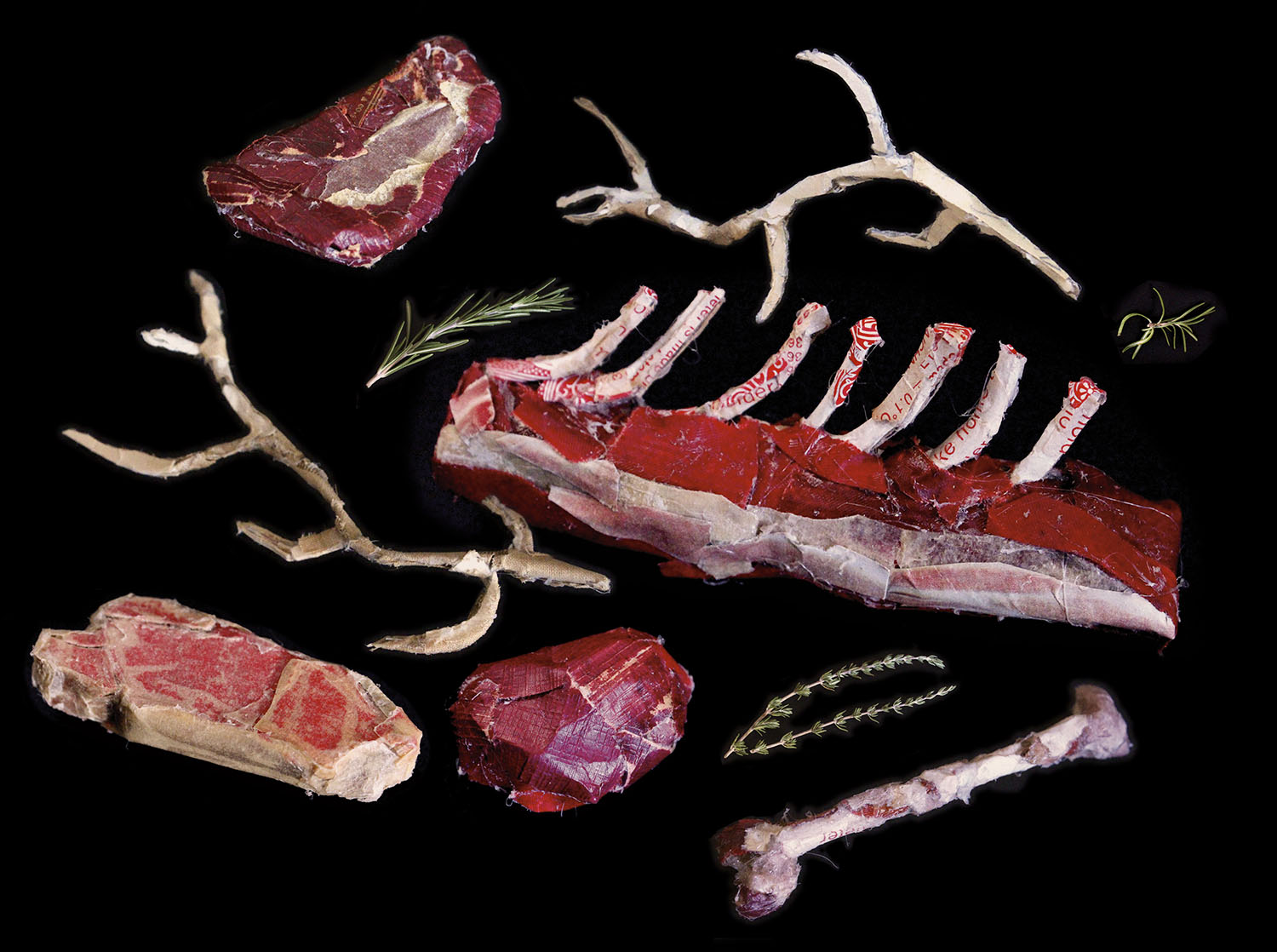
Lydia Ricci’s sculpture has been exhibited in galleries in New York, San Francisco, Marfa, Boston, and Philadelphia, and has been featured in publications such as the Guardian, the Huffington Post, and VICE.